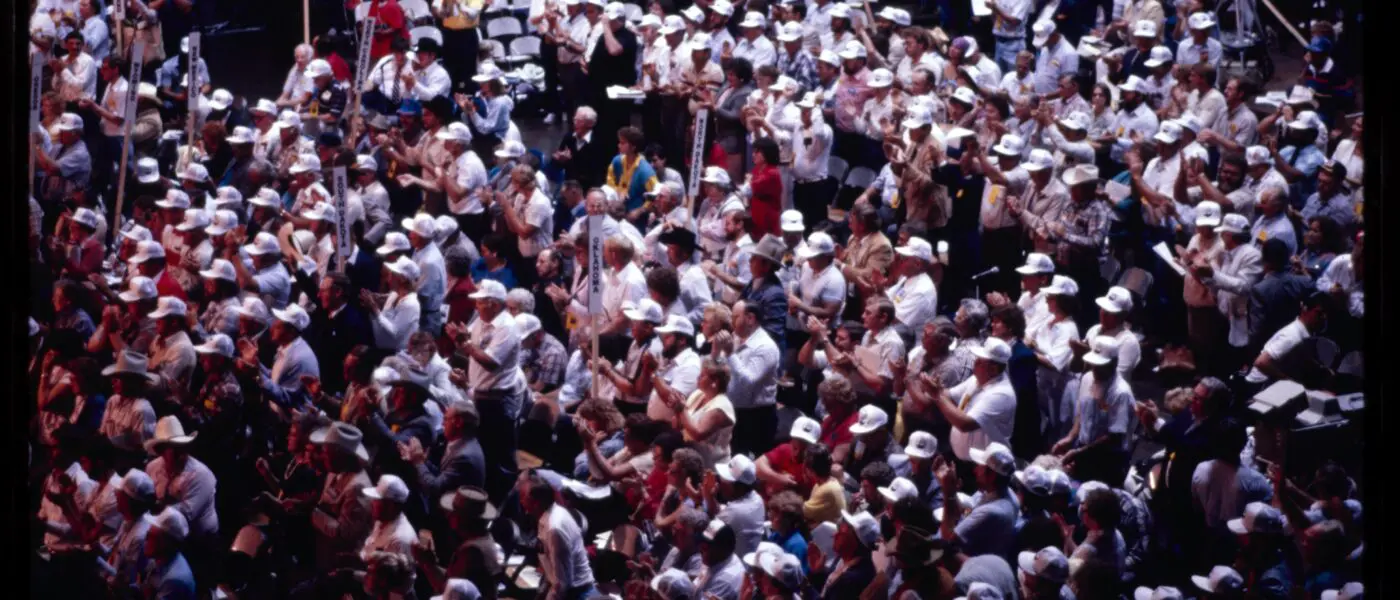
Forty years ago this weekend, nearly 2,000 delegates arrived in St. Louis for an unprecedented gathering: the United Farmer and Rancher Congress. They came together at Kiel Auditorium in the midst of a seeming epidemic of farm foreclosures and in a climate of apparent indifference as the Reagan administration blamed farmers for being “bad managers.”
Not unlike today, when farmers and rural Americans are often stereotyped as a conservative Red State monolith, in 1986, farmers and ranchers had to contend with an American public that knew little of their lives and work and politics (or how a farm crisis could affect their own lives) or of how government policy had caused the farm crisis.
Not long after the first Farm Aid concert raised 7 million dollars in September 1985, several movement leaders and grassroots organizations began talking about the need for a Farmers’ Congress– not only to put forward concrete proposals to help end the farm crisis, but to make a powerful show of unity.
Farm Aid president Willie Nelson saw the UFRC as “the most positive thing to come out of Farm Aid” because, from his perspective as a touring musician and organizer of Farm Aid, he saw that farmers and ranchers in different parts of the country faced similar problems, but had not yet gotten together to try to find common solutions.
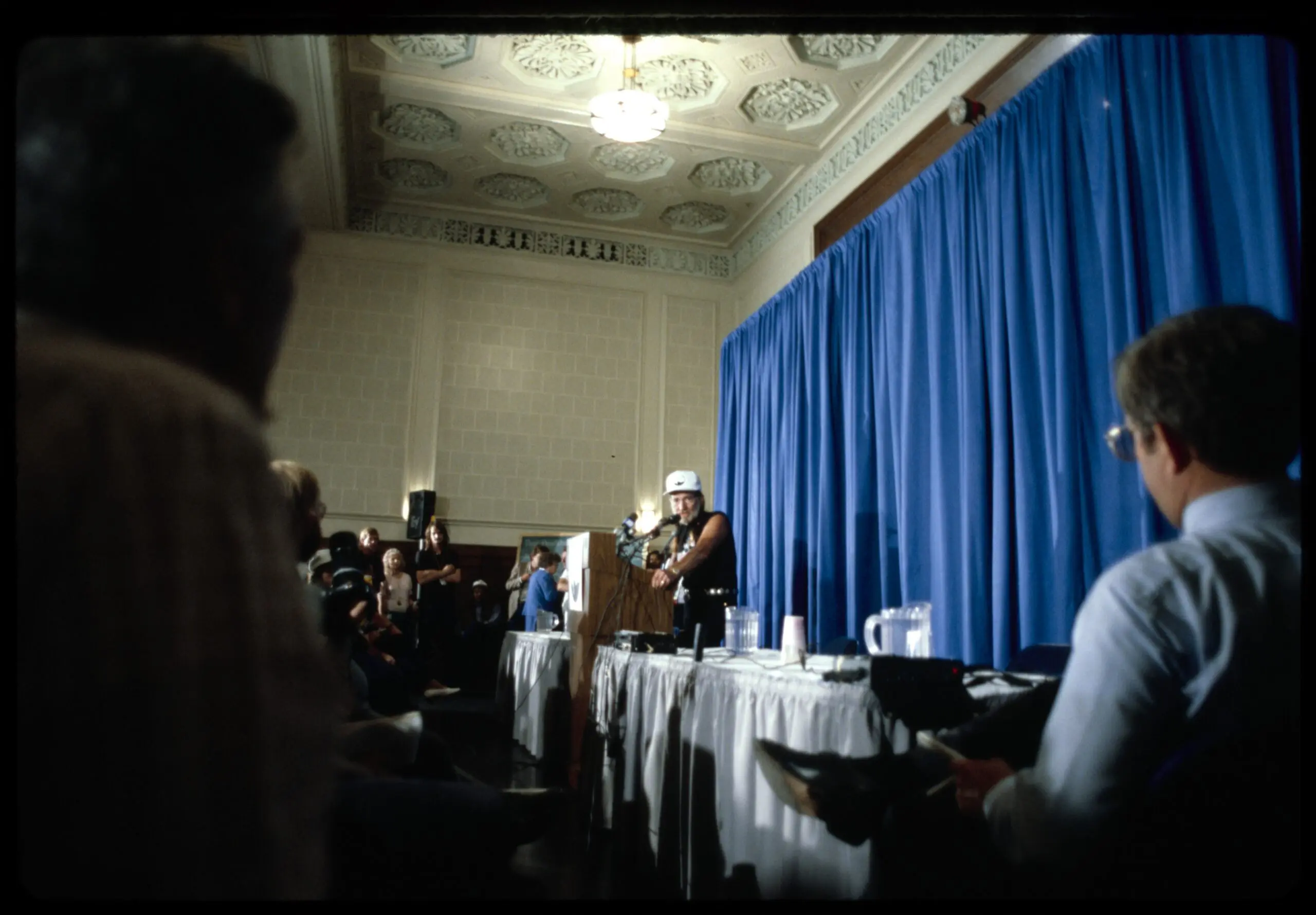
Willie Nelson at the United Farmer and Rancher Congress. Photo © Bill Gallery
Over the course of the summer of 1986, regional coordinators organized nearly 600 rural caucuses to both elect delegates to the Congress and propose resolutions to be discussed in St. Louis.
The nearly 2,000 delegates to the Congress brought a spirit of desperation, but also of defiance. During the Congress’s political convention-style roll call of the states, a Vermont farmer summoned the spirit of his state’s Revolutionary forebears: “Vermont brought sixteen of the Green Mountain Boys and Girls, and we have come with the same intention as the [original] Green Mountain Boys and Girls: We’re ready to fight to save the family farm!” When Texas Agriculture Commissioner Jim Hightower spoke for his state’s delegation, he quoted Harry Truman: “We’re not going to give ’em Hell. We’re going to tell the truth on ’em, and they’re going to think it’s Hell!”
The delegates to the Congress may have spoken in rebellious tones, but they also came prepared to find solutions. The hundreds of rural caucuses had produced thousands of proposed resolutions that delegates received in huge bound binders, organized by county and state. Anne Kanten, Minnesota’s Deputy Agriculture Commissioner and chair of the Congress, held up one of these binders to the assembled delegates and described the task of refining the solutions over the coming days. She quoted the Biblical line engraved on the face of the United States Department of Agriculture building in DC: “The husbandmen that laboureth must be the first partaker of the fruits.” Then, as now, the sense was that farmers were not only not the first partaker of the fruits, but the fruits were being partaken from them.
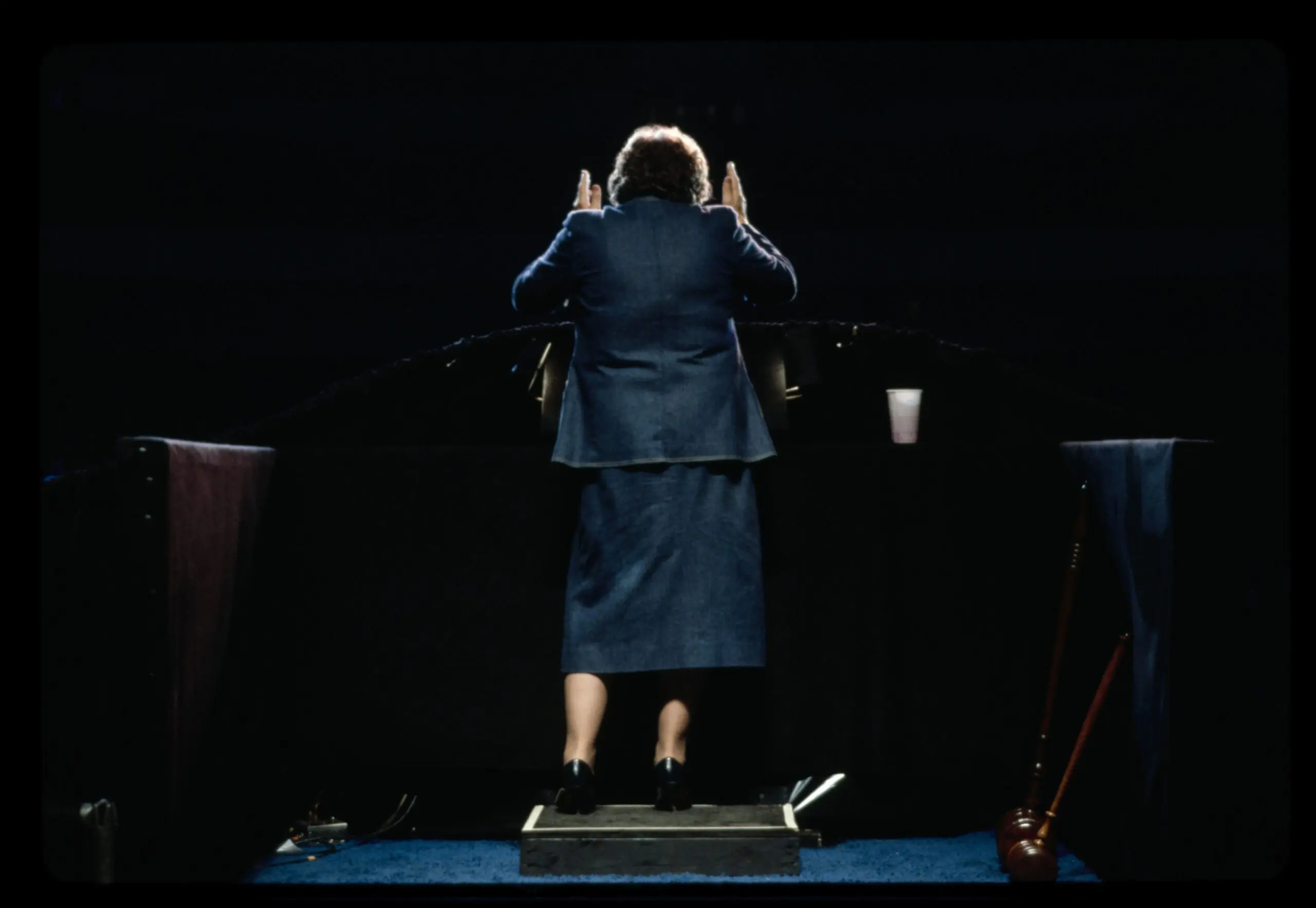
Anne Kanten. Photo © Bill Gallery
A Participatory Democracy
What is remarkable to consider now is that in the midst of the farm crisis and in opposition to far more powerful corporate interests, the delegates of the United Farmer and Rancher Congress deliberately developed a participatory democracy in action. In the rural caucus meetings over the summer, participants pondered not only specific policy proposals, but, more broadly, their vision and hope for rural America. “What do you want your future to look like?” they were asked. “What is YOUR idea of prosperity?” Following the answers to those questions came the questions about policy solutions that would bring about that ideal future.
The stakes then (as now) could not have been higher. Every major speaker to address the plenary sessions of the Congress called out the government’s privileging of the interests of the powerful over the interests of regular people in rural America.
Missouri Lieutenant Governor Harriett Woods addressed the Congress on the first night, presumably to welcome delegates to her state, but used her time at the podium to criticize Washington’s priorities. “If we can restructure loans for Chrysler, if we can restructure loans for Continental Bank, if we can restructure loans for Latin America,” Woods demanded, her voice rising, “then we can certainly do it for the hardworking farm families of America.” The auditorium shook with a standing ovation.
The Reverend Jesse Jackson, who had brought national attention to farm gate defenses and a 145-day blockade of a USDA office in Chillicothe, Missouri, earlier in the year, put it plainly, in words that apply just as much to our own time: “One way to build people’s power is to stop the power of monopolies. Stop the power of corporate greed. Stop the concentration of land into the hands of fewer and fewer people.” How could America claim to have a government of, by and for the people, Jackson asked, if its government served only the few. “Let everybody have some of America. Let America be everybody’s America,” he demanded to another standing ovation.
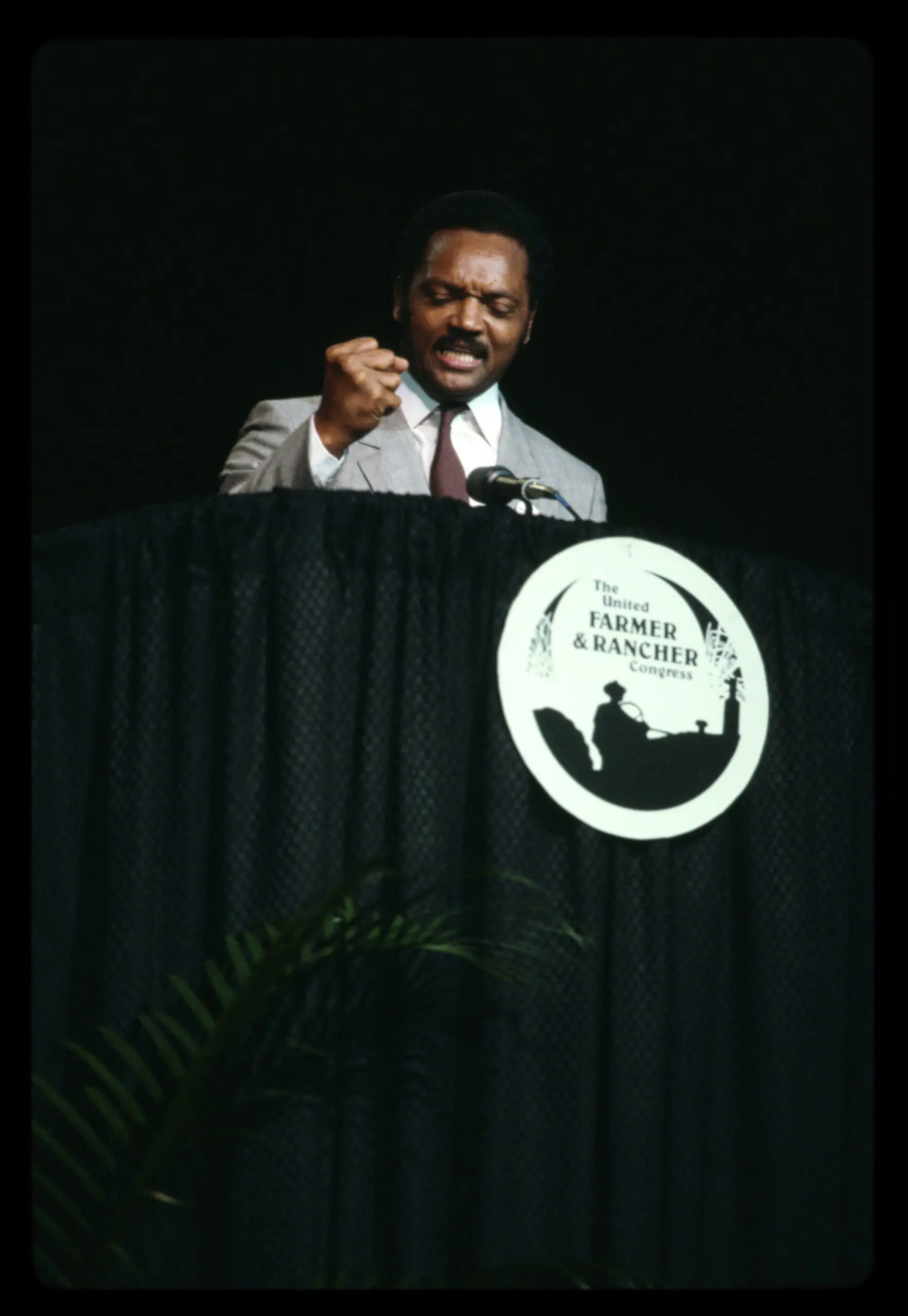
Jesse Jackson. Photo © Bill Gallery
Jim Hightower echoed Jackson, calling the government’s agriculture policy “a policy of greed that enriches a few at the expense of the many… that takes care of the Rockefellers but not the little fellers in our society.” In spite of being the “most efficient, productive, innovative economic unit that has yet been devised,” the American farmer and rancher, Hightower went on, were “in a dog fight with the powerful – in a dog fight with the speculators and the brokers, the bureaucrats and the lobbyists, the shippers and the processors, the ideologues and the ignoramuses who would steal our enterprises, steal our productivity, steal our way of life, and steal our future. What they’re doing, Jesse James got shot for. And we’re here to organize the prevention of that thievery going on any further!”
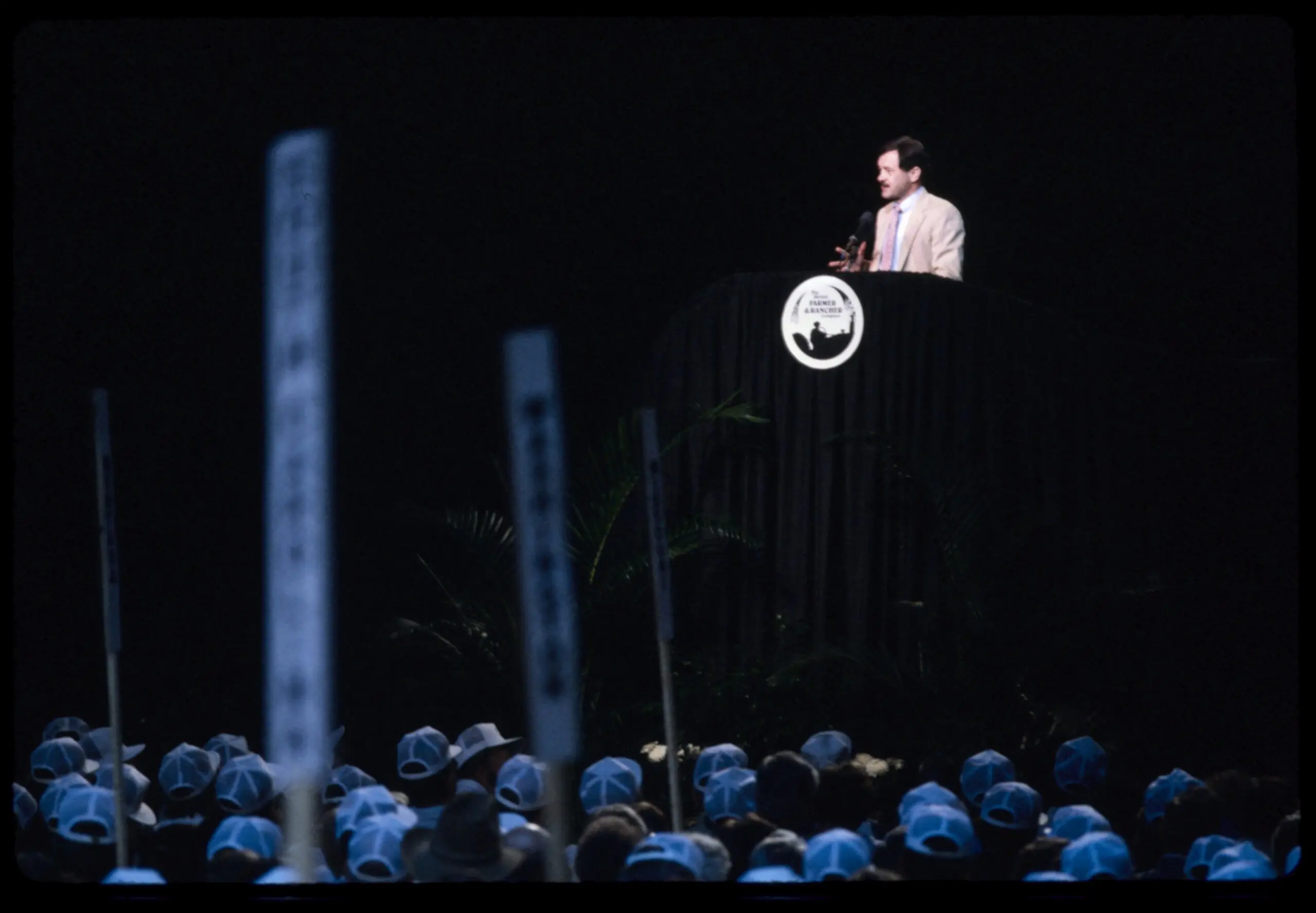
Jim Hightower. Photo © Bill Gallery
Of course, such characterizations of government policy were hardly welcome in Washington, where the “economic happy talk” – as Senator Tom Harkin (D-IA) put it – tried to convince the public that it was “morning in America” because anyone and everyone could take part, they said, in “the Opportunity Society.”
In spite of being in an auditorium filled with 2,000 people, one could hear a pin drop as Harkin told the story of holding a hearing in Iowa and meeting a woman whose family had just lost the farm that they had owned for 125 years. She presented to Harkin the State of Iowa sign that had been mounted on the farm’s fence designating it as an official Century Farm. “Let’s say ‘good morning’ to that century farm family in Iowa,” Harkin scorned. “Morning in America? Opportunity Society?” Harkin questioned, his voice rising in anger. “Bullshit!” he shouted as the audience again rose to its feet. To that Iowa family, it was nightfall in America and more like a stolen opportunity society.
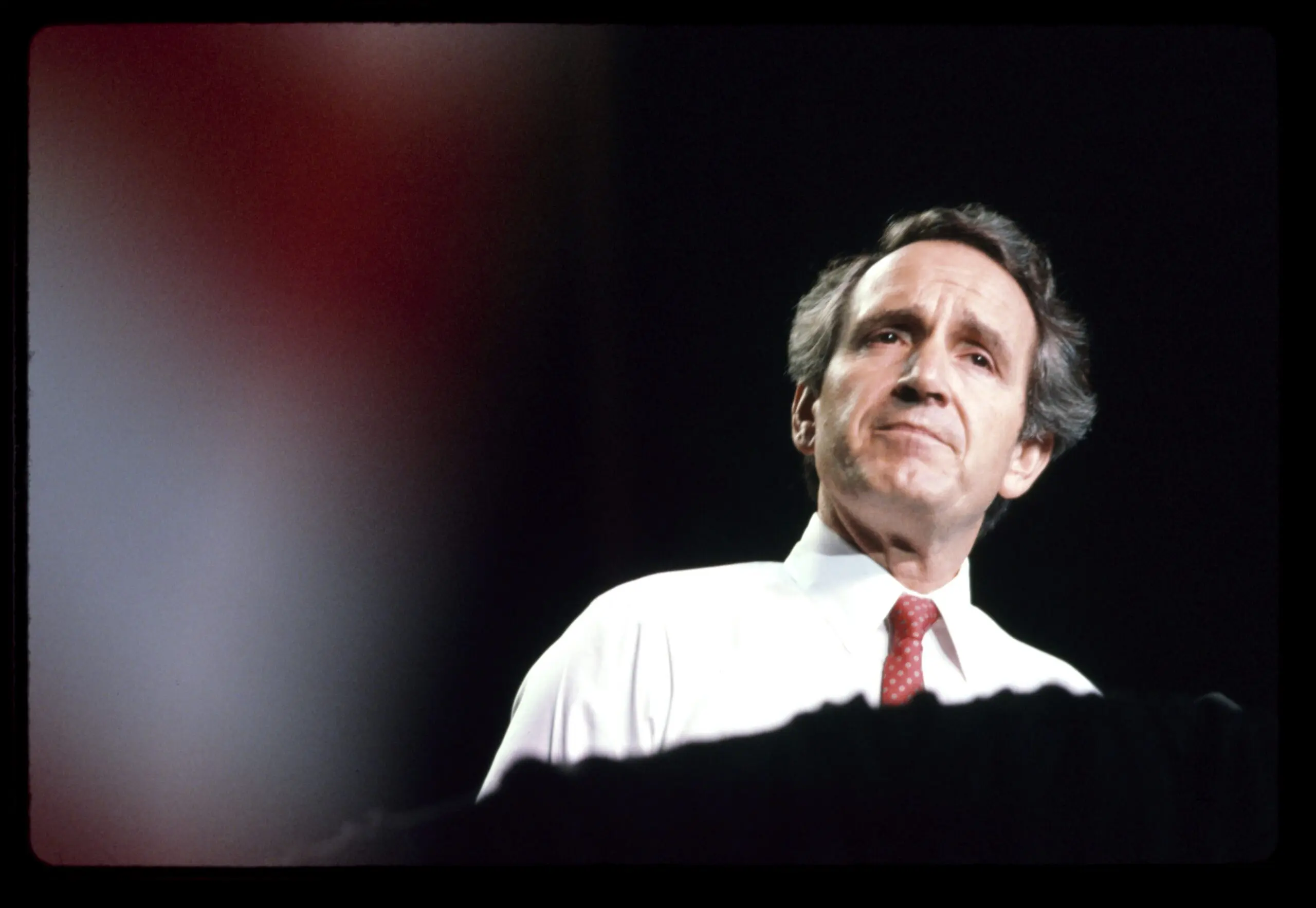
Tom Harkin. Photo © Bill Gallery
Harkin criticized both major political parties, but especially his own for no longer standing with farmers and labor and, instead, taking the side of corporations in exchange for campaign contributions. “We want the government off our backs,” Harkin acknowledged, “but we also want them out of the hip pockets of the corporations” who got all the tax breaks and bailouts.
The Solution is Unity
But organizers did not spend months pulling together the United Farmer and Rancher Congress only to issue forceful condemnations of the powerful. They came with solutions, the most fundamental of which was to stand together and transcend all of their differences. The Congress was incredibly diverse, made up of white, black, Latino and Tribal producers and coming from nearly all 50 states, producing every type of farm product imaginable. When Wayne Cryts of the American Agriculture Movement (AAM) spoke at the first plenary session and appealed for unity, he took off his AAM cap and put on a white UFRC trucker cap. The symbolism of every delegate in the auditorium following suit and taking off their own hats and putting on the UFRC caps may seem trivial, but it signaled a desire to overcome presumed differences and demonstrate solidarity in spite of everything.
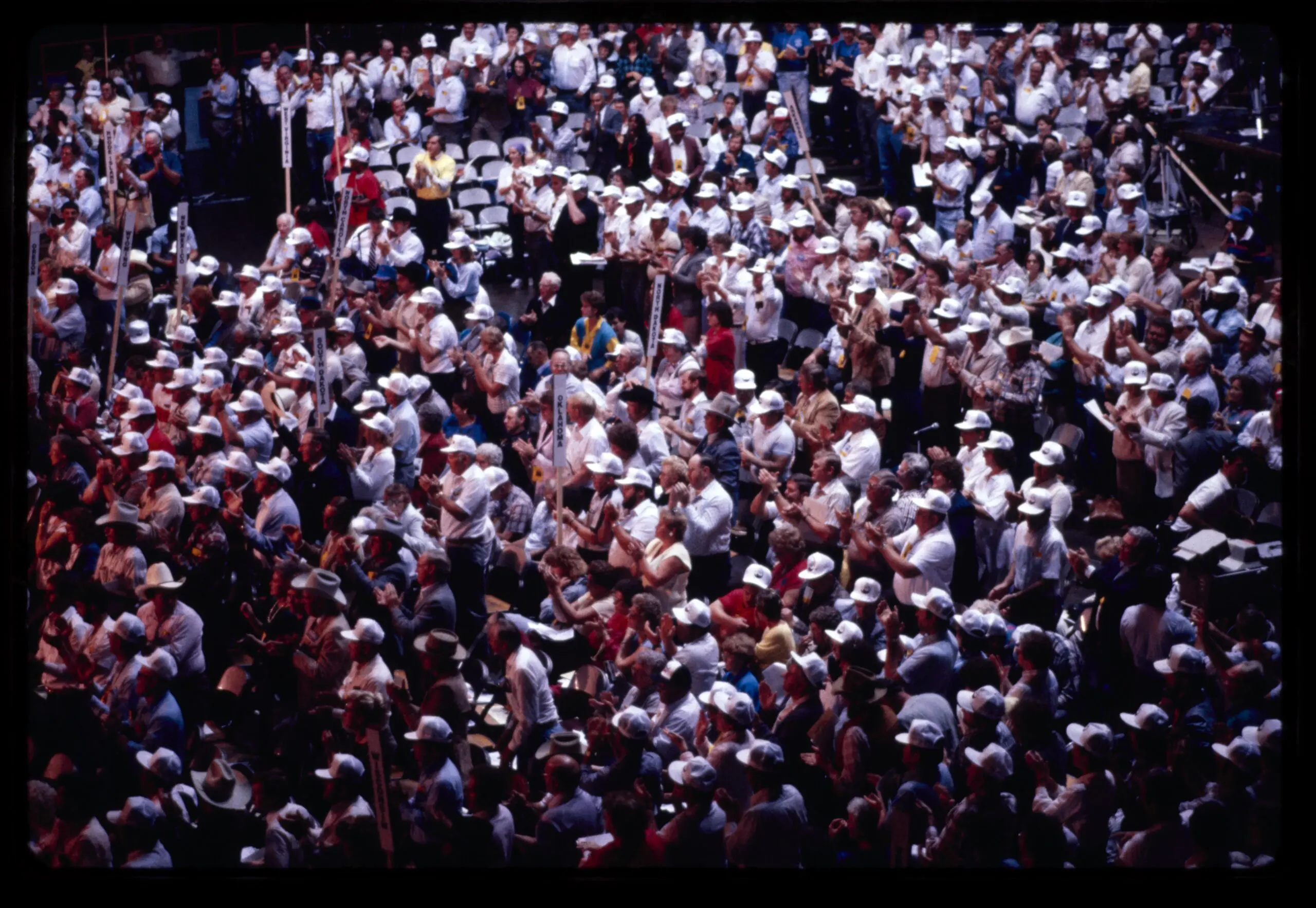
Photo © Bill Gallery
No one spoke more pointedly, or with more authority, about surmounting difference than Jesse Jackson. “Unless we come out of isolation…unless we build a movement of farmers and consumers and workers and other allies, these monopolies will without mercy drive us beneath the soil.” He called on everyone in the room to hold hands and to hold their hands up high and to “turn to each other, not on each other” as the powers that be would want. That unity, he argued, is the basis for real political power.

Left to right: Merle Hansen, Jesse Jackson, Anne Kanten and Ralph Paige. Photo © Bill Gallery
“When the women who birthed our nation and bred our nation and managed our nation… when they coalesce with the farmers who feed our nation, when they coalesce with the soldiers who defend our nation, when they coalesce with the youth who inherit our nation, together we are the new majority.” Another roaring standing ovation.
Doing the work
The three-day United Farmer and Rancher Congress may have been framed by fiery speeches (and celebrated with a concert by Willie Nelson and Family), but most of the time was taken up with sessions at which delegates argued, discussed and refined down the thousands of proposed resolutions to a final set of policy proposals.
Delegates spent almost all of the second day of the Congress in break-out groups organized around particular issues – on land ownership, pricing, credit, tax and fiscal policy, rural economic development, conservation, food quality, education, foreign policy and other subjects – working to distill policies on which the whole Congress could agree. Except for maybe a New England town meeting, this kind of participatory democratic process is a rarity in American life. That evening, while Willie Nelson played a concert for the delegates, a small steering group typed up final resolution proposals to be taken to the printer so that a final set of resolutions could be approved by the Congress and passed along to Harkin and Congressman Richard Gephardt (D-MO) to bring back to Washington.
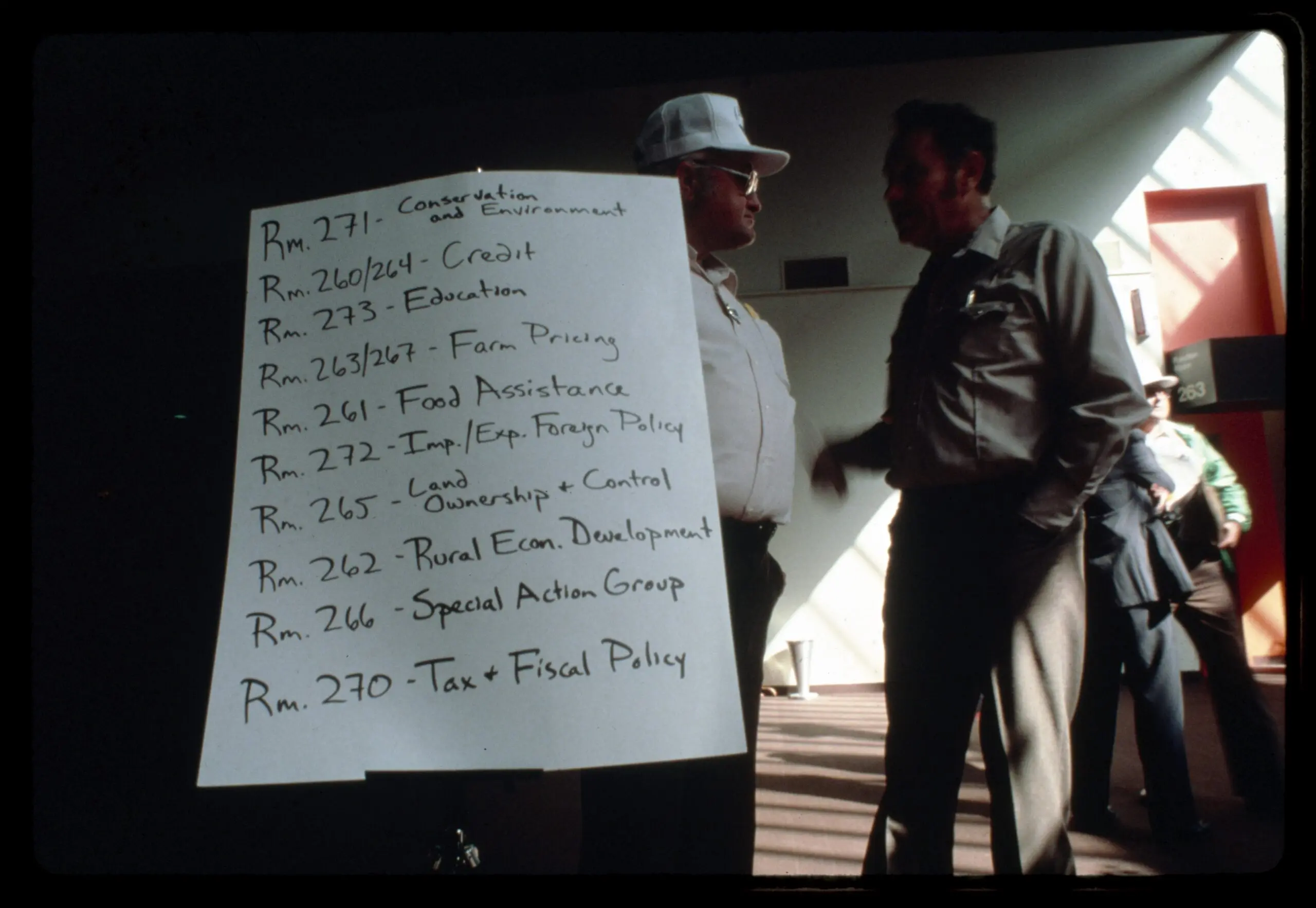
Photo © Bill Gallery
The final resolutions of the Congress are too numerous to get into here (though you can find the report below), but suffice to say that it included many commonsense proposals still not yet adopted: parity pricing 1Although most Americans might not have understood the meaning of “parity,” for farmers it has been a long-standing goal. Parity, as defined by economists going dating back to the Great Depression, essentially measures the price of farm products against other commodities in relation to the prices of items farmers have to buy. In 1986, farm prices stood at 51% of parity, their lowest level since 1933. and supply management; fair credit and farm loan restructuring; keeping the land in the hands of producers and out of the hands of banks, insurers and other absentee landowners; country of origin labeling (COOL) for produce coming from outside the United States; incentives for proper land stewardship and sustainable agriculture.
In the months following the gathering in St. Louis, Tom Harkin and Richard Gephardt brought the final resolutions of the United Farmer and Rancher Congress to Washington to write a bill called the Save the Family Farm Act. The United States Congress nearly passed that bill, but opposition from big agribusiness stopped it short. On the other hand, many of the UFRC resolutions on the issue of credit were incorporated into the Agricultural Credit Act of 1987, the piece of legislation that is widely credited for ending the 1980s farm foreclosure crisis.
Fertile Ground
Forty years later, it would be easy to look back at the United Farmer and Rancher Congress as merely a noble effort that produced mixed legislative results. After all, farmers and ranchers today are beset with many of the same problems they faced in the 1980s, starting with increasingly limited access to land and credit; the overnight disappearance of markets thanks to the government’s shutting down of USAID and SNAP; a capricious roll-out of tariffs that, along with an ill-advised war, have driven up the cost of everything; not to mention the administration’s sledgehammer approach to immigration putting countless farm and food system workers at risk. In 2025, farm bankruptcies soared by 45% and projections are worse for 2026.
If ever we needed another United Farmer and Rancher Congress, it is now. Even if a new UFRC failed to achieve any greater legislative victories, delegates might once again find, as the final report from 1986 put it, “unity in their diversity, respect for their differences, and a new commitment to secure justice for the family farmer and rancher.”
Today, as we are repeatedly (and historically inaccurately) told that we live in a time of unprecedented political polarization, with farmers and rural Americans so often portrayed in unflattering and cartoonish terms (e.g., primarily as voting against their own interests), a new United Farmer and Rancher Congress could revive the progressive populist tradition in the heartland. A new UFRC would showcase, as Jesse Jackson put it, what it looks like when “we turn to each other and not on each other.” Who wouldn’t want that?
 Loading...

 Reload document
  Open in new tab
Loading...
Open in new tab
Loading...
Sources
- 1Although most Americans might not have understood the meaning of “parity,” for farmers it has been a long-standing goal. Parity, as defined by economists going dating back to the Great Depression, essentially measures the price of farm products against other commodities in relation to the prices of items farmers have to buy. In 1986, farm prices stood at 51% of parity, their lowest level since 1933. ↩︎