Learn more about Against the Grain: The Farm Aid Podcast
 Against the Grain brings the magic of Farm Aid’s annual festival to listeners year-round. Hear from farmers and artists, advocates and food experts, activists and policymakers – all of whom are working towards building a more just and equitable farm and food system.
Click here to listen!
Against the Grain brings the magic of Farm Aid’s annual festival to listeners year-round. Hear from farmers and artists, advocates and food experts, activists and policymakers – all of whom are working towards building a more just and equitable farm and food system.
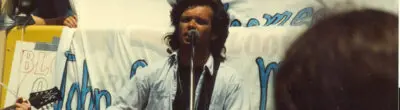
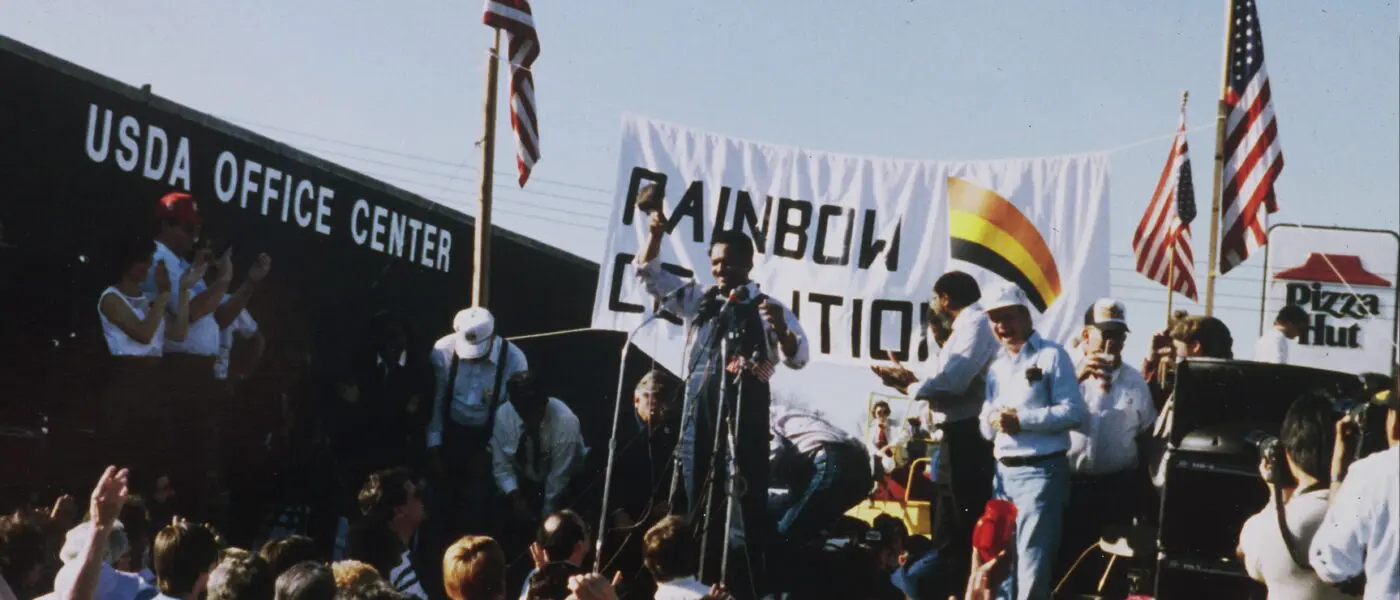
Click here to listen! On May 7, 1986, Farm Aid founder John Mellencamp performed a three-song set from the back of a flatbed truck in a USDA parking lot in Chillicothe, Missouri. That parking lot had been occupied by farmers for 53 days in protest of a county supervisor for the USDA’s Farmers Home Administration (FmHA), and Mellencamp—then one of the most popular rock stars in the country—came to draw an audience and get some attention from the national news media. He succeeded on both fronts: 10,000 people came to Chillicothe to see him perform, and the event was covered by the national news networks on television that evening. But the blockade of the Farmers Home office, and John Mellencamp’s participation, ultimately produced longer-lasting effects and showed what can happen when a broad-based coalition of regular people stand up for each other.
We tell this story in greater detail in a special two-part episode of Against the Grain: the Farm Aid Podcast. We hear not only from Mellencamp himself, but from farmer hero and organizer Roger Allison of the Missouri Rural Crisis Center (MRCC), Rhonda Perry, MRCC’s executive director, and from Farm Aid’s first and longtime executive director, Carolyn Mugar. As we stare down another farm crisis, the story of Chillicothe reminds us that we’ve been here before, fought back—and won!
In the meantime, this companion blog post provides context on some of the complexities of the 1980s farm crisis, the origins and strategies of the family farm movement, and the development of legislation that ultimately helped stem the tide of farm foreclosures.
The 1980s farm crisis
Dating to the 19th century, farmers have always been beholden to external factors, including volatile prices, shifting government policy, lending rates, shipping costs, weather events and the disproportionate power of various middlemen. In the 1980s, a combination of all of these forces led to what seemed like an epidemic of farm foreclosures all across the country that devastated rural communities everywhere.
In many ways, the crisis in rural America mirrored the crisis in industrial America, where formerly thriving cities were left shattered by waves of plant closings in the 1970s. A farm was to a family what a blast furnace was to a steel community; if it ceased to function, so did the family. And when families were forced off farms, formerly vibrant communities in the nation’s heartland turned to ghost towns.
Maybe the most important thing to remember about the 1980s farm crisis is that few saw it coming. Compared to most Americans living through a period of national economic decline, farmers practically thrived in the 1970s. Global grain shortages drove the price of American wheat to historic highs, and with the dollar weak (unmoored from the gold standard), foreign governments could afford to buy as many American crops as they wanted. The Nixon administration told farmers to plant “fencerow to fencerow” and fashioned policies to spur further investment in agriculture. American farmers prepared to “feed the world” by expanding their operations, mostly with money borrowed from banks happy to lend it amid such rosy price forecasts.
But by the late 1970s, the US dollar grew stronger, which led to reduced international demand for American farm products just as fencerow-to-fencerow growing seemed to reach peak efficiency. Prices fell—slowly at first, and then more quickly. By the mid-1980s, farm income had dropped by an astonishing 83 percent.
At the same time, runaway inflation caused the wealth, on paper, of many farmers to grow substantially as their land values continued to climb. “Everybody was extremely optimistic,” one Western Minnesota lawyer and son of farmers remembered. “Everybody borrowed a huge amount of money. We didn’t have any sense at the time that this was anything but good.” But when the Federal Reserve moved to curb inflation by raising interest rates, it meant that farmers had to pay back these loans at higher interest rates and then, as the Fed’s strategy worked, watch their land values spiral downward. In turn, lenders became much less inclined to provide the extra operating money farmers so badly needed.
By the time President Jimmy Carter imposed a grain embargo on the Soviet Union following its invasion of Afghanistan, many farmers were suddenly carrying more debt than they were worth and had no way to make it up. Massive waves of foreclosures followed, and rural communities across the Midwest, especially, began to experience something like another Great Depression.
The crisis only got worse under the Reagan administration. Interest rates continued to rise as the rate of inflation plummeted and prices flatlined. Once those high interest rates made it impossible for farmers to make payments or seemingly ever to pay down their debt, and as rural and agricultural banks themselves failed as a result of the farm crisis, farmers turned to the “lender of last resort,” the Farmers Home Administration (FmHA), a part of USDA set up in the 1940s to help farmers keep their farms following the Great Depression and the Dust Bowl– to refinance their mortgages.
At first, the Reagan team was so confident in its economic program of deregulation, lower taxes, and reduced social spending that it pressed FmHA to keep lending to farmers. But once it became clear that “Reaganomics” could not stop farm values and farm commodity prices from nose-diving, the administration blamed farmers for their own problems. “For the life of me,” director of the Office of Management and Budget David Stockman complained, “I can’t figure out why taxpayers have the responsibility to go in and refinance bad debt willingly incurred by consenting adults who went out and bought farmland when prices were going up and thought they could get rich.” President Reagan himself pledged to eliminate farm subsidies altogether, blaming them for creating a culture of “dependency on the Federal Government.” Later, exasperated by complaints from farm country, Reagan joked at a public appearance that the country “should keep the grain and export the farmers.” Few found this funny.
Of course, farmers had no control over inflation or prices or government policy. They had done everything they had been told to do, followed the rules of successive administrations, only to see their declining land values turn once-sound loans into bad loans—and now they were being labeled “bad managers,” as if they alone were responsible for their struggles. The FmHA and other lenders, at the direction of Stockman and the Reagan administration, thus intensified the farm crisis by initiating countless foreclosures.
It’s worth pointing out that this kind of duplicity on the part of the USDA was not new so much as it was new to this particular demographic of previously successful, mostly white, mostly Midwestern farmers – the American archetype. In fact, tribal producers and Black farmers had been suffering at the hands of capricious policymakers and shifting policy—not to mention outright racism—for decades. As we reported on the podcast in our conversation with partners at the Intertribal Agriculture Council, a variety of forces, from infrastructure to government bureaucracy to lack of credit to land tenure and access and soil issues, make it difficult for tribal communities to produce and distribute their own food. Meanwhile, government policy has facilitated the theft of land from Black farmers. In the 1920s, Black farmers held somewhere between 14 and 19 million acres of land and represented 14% of all American farmers. Today they represent 1% of all farmers and own as little as 2 million acres of land. The two Pigford v. Glickman settlements–-one of the largest civil rights settlements in history–-are an acknowledgement of decades of discrimination at the hands of USDA.
Origins of a movement
American farmers did not think much of policymakers pulling the rug out from under them and then blaming them for falling. As early as the winter of 1977-78, the American Agriculture Movement (AAM) called for a farm strike—a withholding of produce—to press for a number of demands, notably parity pricing. Parity, as defined by economists dating back to the Depression, essentially measures the prices of farm products against other commodities and in relation to their cost of production, including the items farmers have to buy. In 1977, farm prices stood at 67 percent of parity, their lowest level since 1933. Farmers argued that 100 percent parity—when the market value of farm commodities essentially matched that of manufactured goods—had been institutionalized by New Deal acreage limitation programs, but by 1977, the government had sold out farmers by designing policies that kept food cheap so that Americans could afford to buy other goods and keep the economy afloat. “The products and goods and services that we have to buy, they’ve increased [in price] from 500 to 1500 percent and we’re still selling our product at the same old price we had in 1948,” said Alan Gains, president of the Oklahoma branch of AAM.
AAM grew from a group of forty Colorado farmers and ranchers in September 1977 to a national organization with eleven hundred local offices in forty states in January 1978. Strikingly, AAM farmers drove their tractors off their fields and into the streets. The defining image of the movement was the long convoy of tractors known as a tractorcade. They started state-by-state, with tractorcades in Georgia, Texas, Nebraska, Minnesota and beyond, before 3,000 farmers drove their tractors to Washington, DC. They came back again the following winter with even more farmers, but parity remained out of reach as the foreclosure crisis deepened and demanded a change in tactics.
Missouri
Throughout the Midwest farmers began reviving Depression-era tactics such as the “penny auction,” the sit-in and farm gate defenses to thwart foreclosures. In penny auctions, organizers arrived and convinced anyone in attendance not to bid more than a few cents or a dollar at most, so that the bank or FmHA got no proceeds and the auctioned items could be returned to the farmers being foreclosed upon. Ideally, as happened in some situations, the bank would see that renegotiating a loan made more sense than facing a hostile crowd and the likelihood of a failed auction.
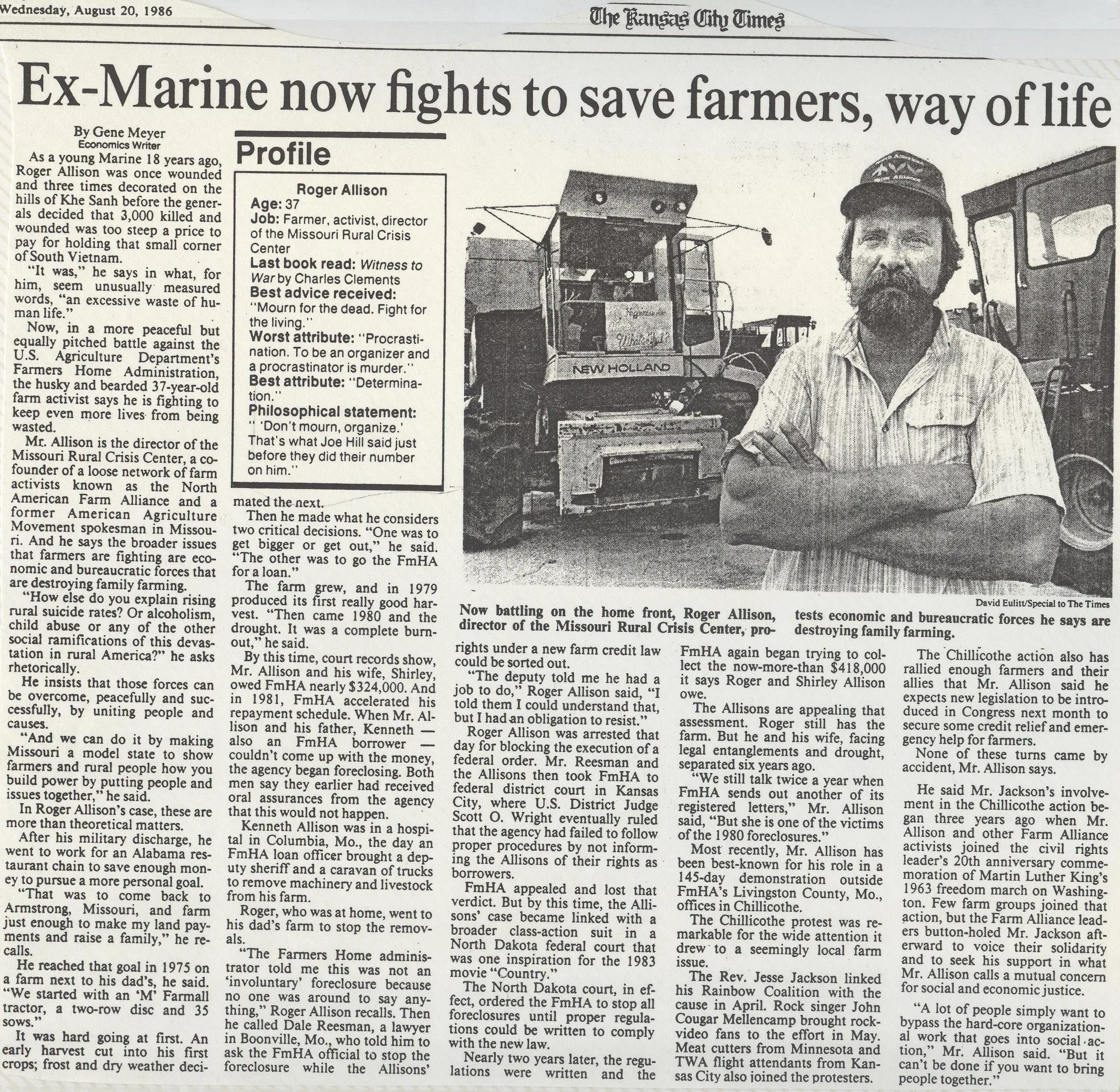
In Missouri, Roger Allison, a decorated Vietnam veteran, became something of a local legend in October 1980, when he physically stood in the way of FmHA officials foreclosing on his father’s farm. He was arrested for his pains, and two weeks later the FmHA county supervisor notified him that he wanted to review Allison’s files, too. “We’re gonna sell you out,” he boasted to Allison, and in April 1981, the foreclosure notice arrived. But Allison sued in federal court and won. Allison v. Block, a landmark court ruling, compelled FmHA to give borrowers across the country the opportunity to seek deferrals of their loan principals and interest. The basis of the ruling was a law signed into effect by Ronald Reagan early in his term called 7 USC 1981a (a provision of Consolidated Farm and Rural Development Act), but which Reagan’s own USDA was now routinely violating by not offering borrowers the chance to defer loan payments and avoid foreclosure.
Roger’s case set an important precedent for a national class action suit, Coleman v. Block, brought by Sarah Vogel in North Dakota. You can read all about that case in Sarah’s brilliant book “The Farmer’s Lawyer.” In granting a legal victory to the thousands of farmers in the plaintiff class, the court found, among other things, that the Farmers Home Administration had coerced farmers into foreclosure and did not provide adequate due process on appeal.
In Missouri, however, these rulings were not enough to save Perry Wilson’s farm in the spring of 1985. Wilson, who started farming in 1933, had 820 acres of land, but was being foreclosed upon by the St. Louis Federal Land Bank because he had missed one payment in 1984—the first time in fifty-one years. On March 15, outside the courthouse in Plattsburg, more than a thousand people gathered to shout, “No sale! No sale!” as the sheriff auctioned off 700 acres of Wilson’s land. The protestors were rewarded with beatings from police billy clubs, and eight were arrested. A month later, Reverend Jesse Jackson and civil rights leaders from Kansas City arrived to try to stop the sale of the rest of Wilson’s land. “This is a rainbow coalition for economic justice,” Jackson said. “When a baby goes to bed supperless, the baby doesn’t cry race. The hungry cannot eat without the farmer, and the farmer cannot be saved without the hungry… We need more farms, not more arms. We want more grains in our silos, not more missiles in our silos.” Despite this concerted, high profile effort to save the Wilson farm, it all sold at auction.
Chillicothe
But as Rhonda Perry and Roger Allison told us when we interviewed them for the podcast, what happened in Plattsburg set the stage for what was to come in Chillicothe. There, as you hear throughout the podcast, the same multiracial, working-class coalition of civil rights activists, labor organizers and farmers came together to protest the way the FmHA county supervisor in Chillicothe continued to abuse farmers and foreclose upon them. He ignored the authority required of him under 7 USC 1981a to help farmers defer payments and avoid foreclosure; in fact, he did quite the opposite, looking for ways to foreclose everywhere possible.
You can learn more about what happened by listening to the podcast, but suffice to say that the Missouri Rural Crisis Center—founded with a grant from the first Farm Aid concert and led by Roger Allison—built the perfect strategy to blockade the Farmers Home office in Chillicothe, draw national attention to the farm crisis, and shore up the foundations of organizations like MRCC and Farm Aid that are still fighting to this day. The participation of Jesse Jackson and Farm Aid’s John Mellencamp helped bring national attention and helped keep the blockade going for 145 days until it ended in August of 1986.
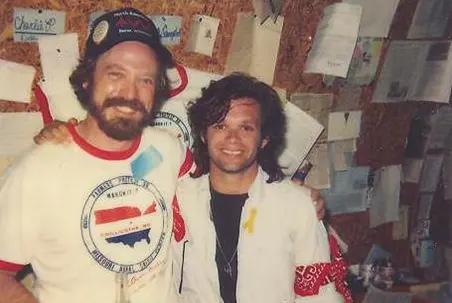
Roger Allison and John Mellencamp
The Agricultural Credit Act of 1987
Although farmers organized all over the country, Missouri seemed to be ground zero for the family farm movement in 1986. The demands that MRCC and others made of the USDA during the Chillicothe blockade showed up again and were echoed by thousands of delegates to the United Farmer and Rancher Congress (UFRC), held in September, at the other end of the state in St. Louis.
We will have more to say about the UFRC in the coming months as we prepare to mark its 40th anniversary, but maybe the most important takeaway is that the work of the Farmer and Rancher Congress directly informed the writing of the Agricultural Credit Act of 1987, the legislation widely regarded as “stopping the bleeding” of foreclosures in farm country. As Rhonda Perry points out in the podcast, the roots of the Credit Act, which established requirements for the FmHA to restructure delinquent loans (rather than foreclose on them) and provide mediation services, grew out of the grassroots efforts of that multiracial working-class coalition so visibly on display during the Chillicothe blockade.
Not only did the protest win immediate relief in Chillicothe, but it inspired the ongoing work that ultimately led to life-saving and farm-saving Congressional legislation. As we look for inspiration today, with farmers once again facing disappearing markets, inflated costs in inputs, low prices and shifting government policy, these are all victories worth celebrating.