U.S. farmers have recently faced consecutive years of high input costs and low commodity prices, decreasing the already small margins that many operations get by on. And while these conditions alone are difficult enough to navigate, additional challenges have only increased uncertainty for U.S. farmers. Farmers have been hit from every direction: seesawing tariffs, damaging trade policies, inflation and drastic cuts to federal farm programs. These impacts combined with decades of agriculture policy that favors large-scale, industrial operations and corporations, are bringing many farmers, and the rural communities they support, to a breaking point.
After a tumultuous year, the outlook for 2026 does not offer much hope for improvement. Farm income is forecast to remain low; input costs continue to rise as tariffs remain a frequent tool of the Trump administration leading to lower agricultural exports and a tarnishing of the U.S.’s role as a trading partner; and now farmers and ranchers are facing yet another variable with the recent military action by the U.S. against Iran. The result? Global financial turmoil and additional increases in the cost of fertilizer and fuel, along with impacts to its availability—right as farmers plant their fields and prepare for the growing season
Last year, farmers, advocates and policymakers began to warn that we’re entering the next farm crisis, as farmers across the spectrum struggled to make a living. In the first quarter of 2026, we’re seeing this warning bear fruit, and there is no sign of these conditions easing. And in case you’re wondering (and probably already experiencing), these economic challenges don’t just add up for farmers, they hit all of us who eat in the price of our food.
Farm Crisis Updates
When it comes to the farm economy, there’s a lot to cover. Stay tuned to this post for updates as planting season continues and we get more clarity on how farmers are faring. We’ll bring you updates from economists, policymakers and the folks on the ground who experience these challenges directly: farmers.
Over 100 Food and Farm Organizations Demand Fair Credit for Farmers
July 22, 2026
In response to U.S. farm debt reaching historic levels, over 100 organizations, including Farm Aid, sent a letter to Congress urging reforms to agricultural credit and oversight at the U.S. Department of Agriculture (USDA). Farm Aid and these organizations are pressing for the passage of the Fair Credit for Farmers Act of 2026.
“With U.S. farm debt expected to climb over $620 billion this year, steady declines in the number of farms, and an upward trend in bankruptcies in recent years, it is critical that the credit provided by the USDA’s Farm Service Agency (FSA) is supporting farmers’ economic resilience,” the letter says.
“As the 2026 House Farm Bill draft contained few credit provisions to the benefit of these producers, we believe Congress must take even bolder action to ensure basic borrower protections for farmers, and to make FSA loans fairer, more accessible, and less risky,” the letter continues.
The Fair Credit for Farmers Act would protect farmers’ homes, improve credit access and terms, strengthen farmer-borrower rights and give economically distressed farmers relief via two-year, low-interest payment deferrals. The bill is cosponsored by Senator Kristen Gillibrand (D-NY), Senator John Fetterman (D-PA), Representative Jennifer McClellan (D-VA) and Representative Jim McGovern (D-MA).
Click here to take action with our partners at National Family Farm Coalition and support the Fair Credit for Farmers Act in the next farm bill.
How the War in Iran Impacts U.S. Farmers
July 15, 2026
On February 28, 2026, the U.S. joined Israel to launch air strikes on Iran. It might not be immediately obvious that a war across the globe would have an impact on U.S. farmers. But it has, adding significantly to the stress farmers were already feeling due to low prices, rising input costs, tariffs, lost markets and other issues. How can that be? Because in reaction to the attacks, Iran closed the Strait of Hormuz, bringing traffic to a standstill in one of the world’s busiest oil and fertilizer shipping channels.
Most farms rely on those two products—fuel (derived from oil) and fertilizer—and almost immediately after the first strikes on Iran, the prices for these products rose precipitously. As weeks went by and the conflict spread to other countries in the Gulf Region, what was intended to be a short conflict dragged on and farmers took a big financial hit. The war began right at planting season, the time for fertilizer to go in the ground along with seeds for crops. Farmers who had not pre-purchased their fertilizer scrambled to find supplies and paid significantly more than they budgeted for it. Those who couldn’t afford the extra cost, had to make due with what they could afford and access, which will impact their eventual harvest.
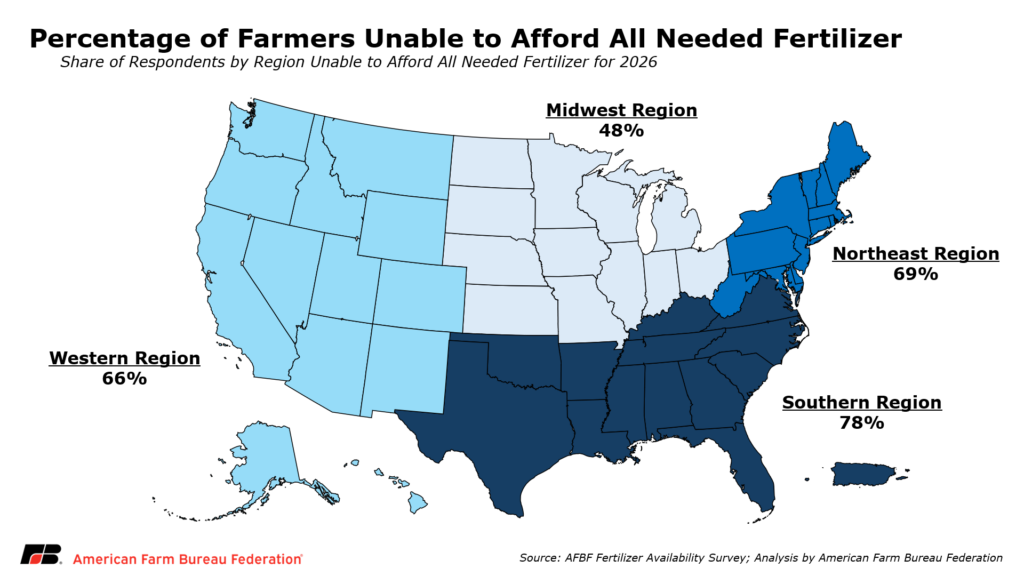
While the USDA downplayed the war’s impact on farmers, Farm Bureau released results of a survey of farmers conducted in early April 2026, finding that 70% of farmers surveyed could not afford to purchase all the fertilizer they needed for planting. Depending on the type of fertilizer, costs have risen by as much as 25% since the Middle East conflict began.
Farmers also felt the pain from another essential input suddenly getting more expensive: fuel. Like everyone else, farmers watched as the cost of fuel increased sharply, making it more expensive to run the equipment they rely on to plant, nurture and harvest crops. Global crude oil prices, which are the foundation for diesel and gasoline, jumped about 30% since late February, driving the cost of diesel, the most commonly used fuel on farms, up more than 40% since February.
It was a relief for farmers when a cease fire was finally agreed to on June 14, ending hostilities, reopening the Strait of Hormuz and lifting an American naval blockade on ships traveling to and from Iranian ports. Shortly after, prices for both fuel and fertilizer began to level off, though farm economists were clear that even as prices dropped, the impact on farmers would remain.
But any relief that farmers felt at the announcement of a ceasefire was quickly lost as the unstable peace again and again came into doubt. This week hope for a lasting resolution suffered a fatal blow, with President Trump formally notifying Congress that the nation is once again at war with Iran. This notice gives his administration another 60-day clock to use the military in the region without congressional approval. As a result, farmers are once again in the same position they were: dealing with rising costs and potentially limited supply for two of the major inputs they need not just to plant, sustain and harvest their products, but to get them to market as well. As with all the challenges farmers face, this situation will likely keep changing. We’ll keep you posted.
On a positive note, the turmoil with the fertilizer industry has many farmers thinking about how they can protect themselves from these kinds of supply-chain disruptions in the future and looking for other ways to replenish their soil, such as manure, compost and cover crops. Farm Aid’s partner Land Stewardship Project launched a new effort called Rethink Nitrogen, which helps farmers understand how they can be productive and profitable while also protecting our water, soil and health from the dangers of over-application of fertilizer. You can read more about it here.
Raising the Alarm Bill About the Farm Economy
(These Folks Should Know And Congress Should Listen)
April 27, 2026
In February, a bipartisan group of 27 influential figures in the farming industry, including former heads of commodity groups and USDA officials, wrote a public letter to Congress. The letter called on Congress to reverse the Trump administration’s agriculture policies, citing “tremendous harm” and the possible “widespread collapse of American agriculture.” Echoing a refrain from the first days of Farm Aid that remains true now, they wrote that when farmers suffer, “the entire rural economy is impacted—from schools, to churches, to main street businesses.”
Though not breaking news, this letter is important to highlight as we set the stage in this cumulative post for the current farm economy as an unprecedented return to crisis. Authors of this letter have deep knowledge of both the farm economy and agricultural history–they’ve had influence over both. That’s why this letter serves as such a stark warning-–a clarion call for change to avert disaster.
The letter calls out the administration as well as Congress, stating, “it is clear that the current administration’s actions, along with congressional inaction, have increased costs for farm inputs, disrupted overseas and domestic markets, denied agriculture its reliable labor pool, and defunded critical ag research and staffing.” It further points out, “these impacts are not happening in a vacuum. At the same time that farm country is reeling from these blows to agriculture, rural health care cuts are threatening a vital safety net for America’s farm families. Congress needs to assert itself on behalf of farmers if we are to avoid a widespread collapse of American agriculture and our rural communities.”
The letter proposes solutions that Congress and the administration could enact, including ending tariffs on farm inputs, expanding international export markets, passing a new farm bill, passing farm labor reform and restoring funding that has been cut in the first year of the Trump administration for agriculture research and staffing. In the nearly three months since the publishing of this letter, the House has begun to move the farm bill forward, as well as propose legislation around increasing ethanol production, but for the most part, the challenges farmers face continue to go unanswered by Congress and this administration.
To read the full letter, click here.
Farm Bankruptcies Increased 46% in 2025
April 13, 2026
In February 2026, the American Farm Bureau Federation released a report that substantiated what many farmers and agriculture economists have been saying: We are experiencing a new farm crisis. The report found that Chapter 12 family farm bankruptcies surged by 46% in 2025 to 315 filings, marking the second consecutive year of increases.
High production costs, high interest rates, and declining commodity prices are driving this financial distress, particularly in the Midwest (which claimed more than a third of the bankruptcies and saw them rise by 70%) and the Southeast (where Arkansas had the greatest number of bankruptcies of any state and the largest year-over-year increase).
Chapter 12 is a form of debt restructuring specifically for farm businesses, which allows them to restructure debt and continue farming. Using Chapter 12 filings as a barometer of the farm economy is telling, but one danger is that it is a “lagging indicator.” Farm bankruptcy is a farmer’s last resort, with financially distressed farmers often first maxing out lines of credit, personal credit cards and their savings to keep the farm.
Additionally, using Chapter 12 as a measurement of the farm economy has become less useful as many farms have become reliant on off-farm jobs. Chapter 12 requires that the farm family earn the majority of their income from the farm—something that has become more difficult as farm income falls and because many farmers and/or their spouses rely on an off-farm job to access health insurance. According to USDA’s Economic Research Service, nearly half of all farmers reported having a job off the farm in 2022. Chapter 12 filings, therefore, do not provide a comprehensive look at farms that have ceased to operate or been consolidated into a bigger farm.
Nonetheless, seeing farm bankruptcies rise so substantially during 2025 clearly indicates that American agriculture is in trouble—no matter how forcefully the USDA claims that farmers are experiencing a “golden age.”
Watch “The Farm Crisis”
The Farm Crisis is a 2013 documentary from Iowa PBS that examines the tragic circumstances faced by farmers for most of the 1980s, when thousands were forced into bankruptcy, land values dropped by one-third nationally, and sky-high interest rates turned successes into failures seemingly overnight. Explore why the farm crisis of the 1980s happened, meet the farm families who struggled and the men and women who fought so long and so loyally to help them, and examine how agriculture changed as a result of the crisis.
Watch the film on IowaPBS.org or on YouTube.