Our new podcast series!
 Listen to the Artists and Activism series of Against the Grain: The Farm Aid Podcast to hear from more than two dozen artists who use their art and voices as vehicles for political engagement and expression on issues that matter to them.
Listen here!
Listen to the Artists and Activism series of Against the Grain: The Farm Aid Podcast to hear from more than two dozen artists who use their art and voices as vehicles for political engagement and expression on issues that matter to them.
Listen here! 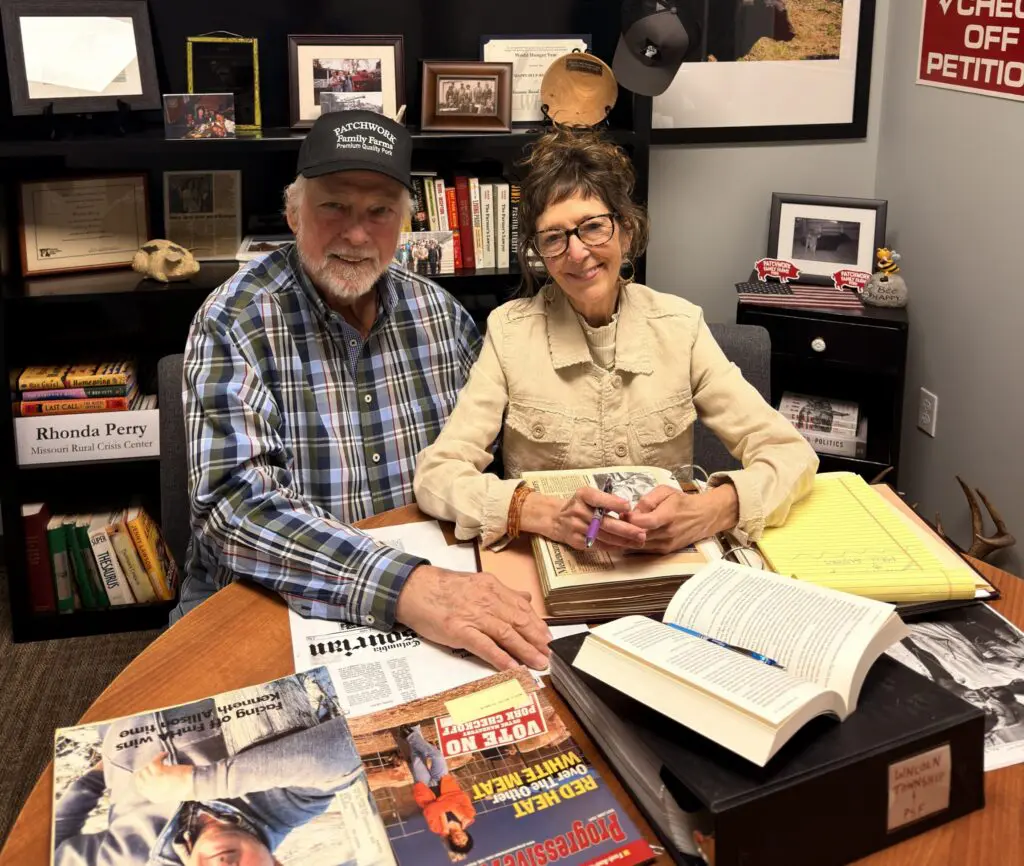
Rhonda Perry and Roger Allison
Roger Allison founded the Missouri Rural Crisis Center (MRCC) in 1985, creating the infrastructure and organizational home to continue building power to fight illegal foreclosures of family farms during the 1980s Farm Crisis. Throughout those harrowing days, Roger was a fierce advocate not just for his fellow farmers but also for racial and social justice, as he helped build the movement. Rhonda first came across Roger and MRCC at a farmer’s protest in 1986. A few years later, in 1991, she attended the MRCC annual meeting with her parents, where she spoke with Roger and decided this was her forever calling. Fun fact: Rhonda’s parents were founding MRCC members, and later became some of the first Patchwork Family Farms hog producers. As a 5th-generation farmer coming to the work through her own family’s fight to stay on their land, Rhonda was inspired by the courage of her fellow rural people organizing for their farms, families and communities at the 1991 annual meeting and soon after joined MRCC’s staff. She began her MRCC journey as the Program Director, fundraising to pay for her own position, and eventually became the Executive Director in 2020. Over the last 35 years, she has helped carry the movement forward with grit, compassion and unshakable commitment to family farms and rural America. And Roger continues to play an integral role as the Director of Operations, overseeing processors, producers and the Patchwork Family Farms team.
Being farmer-led isn’t the only thing that makes MRCC so special. It has always been important to MRCC to not only fight for the policies that will provide farmers a fair price, create access to markets, and strengthen rural communities, but to also consistently challenge the industrialization of agriculture by providing on-the-ground examples like Patchwork Family Farms, showing what can happen when farmers and consumers come together.
Patchwork Family Farms Pork was created in 1993 to support local hog farmers and bring high-quality, sustainably-raised, independent family farm pork to all consumers regardless of income or zip code. Patchwork promotes sustainable agriculture and animal husbandry practices, provides hog farmers with fair market prices, and provides accessible local food (since way before it was called “local food”). Patchwork buys from Missouri producers and works with independent processors to get thousands of pounds of family farm pork to consumers, grocery stores and restaurants. In fact, for over 25 years Farm Aid concertgoers have been able to experience Patchwork pork chops, ham steaks and brats at every Farm Aid concert across the country.
Together, Rhonda and Roger have nurtured a powerful team of leaders at MRCC who bring a strong sense of community, connection and purpose to everything they do, whether they’re organizing farmers, building relationships across rural and urban communities or protecting our land, water and food supply. Outside of co-running the organization, Rhonda and Roger co-run life on the farm. They merged their cattle herds—and got married—in 1996 and continue to run their cow/calf operation on 850 acres in Howard County, Missouri. In addition to their cows, they also enjoy fishing, recording nature and the farm through photos, and taking care of their collection of other animals who have come to live on the farm, including three dogs, two horses and nine cats.
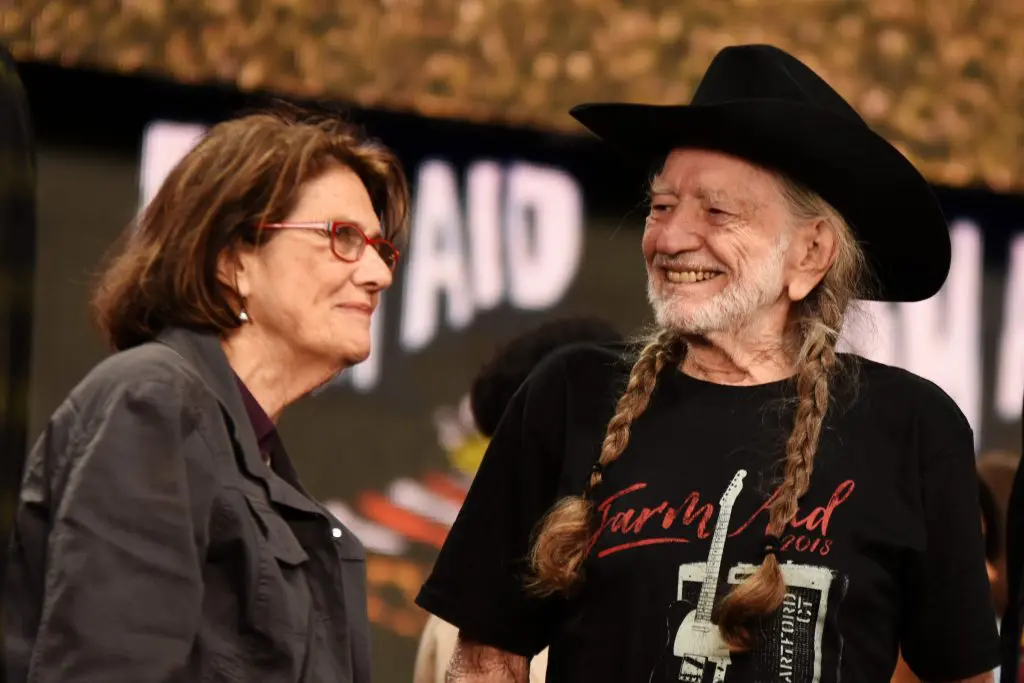
Carolyn Mugar and Willie Nelson on the Farm Aid 2018 Press Event stage. Photo © Brian Bruner / Bruner Photo
Carolyn Mugar
Farm Aid’s first executive director Carolyn Mugar has an extensive resume of socially-conscious experience. The social and political issues she’s tackled include labor, environment, toxics, literacy and community empowerment. Prior to her work with Farm Aid, Carolyn was a union organizer with the Oil, Chemical and Atomic Workers International Union and the Amalgamated Clothing and Textile Workers International Union. In 1985, Willie Nelson asked her to help determine how the funds raised from the first Farm Aid concert should be distributed. Carolyn traveled across the countryside to visit the families who were being pushed off the land. She says she had always wondered what held the two coasts together, and that she learned a lot about that while visiting farm families at their kitchen tables. Carolyn served as Farm Aid’s executive director for 39 years, through 2024, and remains active with the organization to this day.
In addition to her work at Farm Aid, Carolyn founded The Armenia Tree Project, a reforestation project based in Massachusetts and Yerevan, Armenia. As a person of Armenian descent, she is deeply involved in issues impacting Armenians and travels there several times a year. Over the past 30 years, the Armenia Tree Project has planted more than 9 million trees and shrubs in forests, school yards and sites of cultural significance, removing an estimated 100,000 tons of CO2 annually.
 John Mellencamp
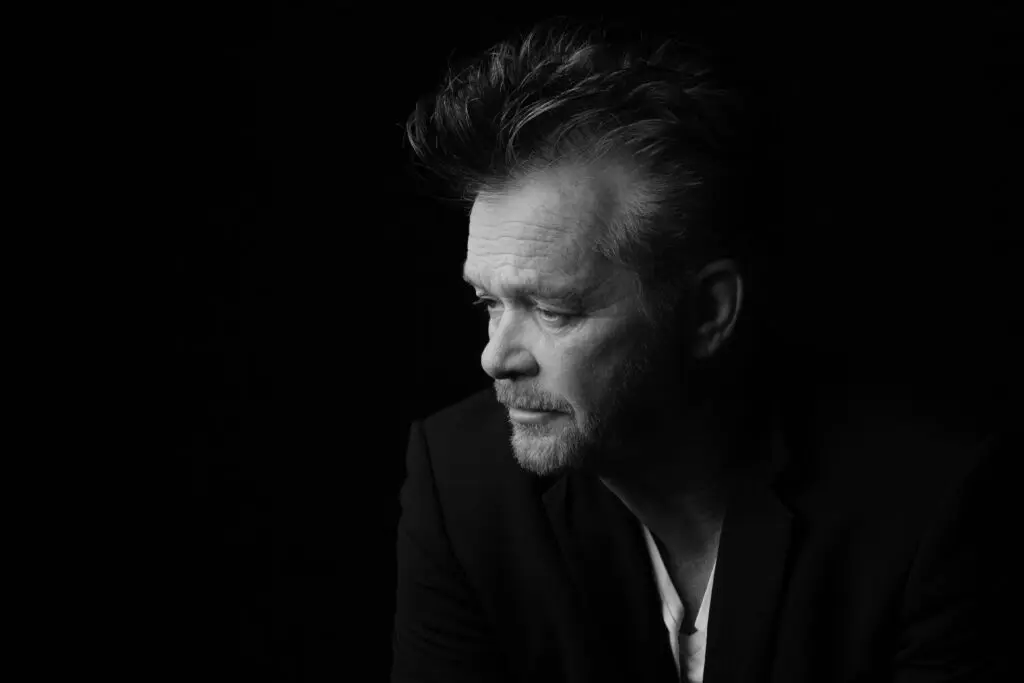 John Mellencamp
John Mellencamp is one of the most highly respected singer/songwriters of his generation. In recognition of his achievements in a music career that now spans more than 50 years, Mellencamp is a member of the Rock and Roll and Songwriters Halls of Fame, a recipient of the John Steinbeck Award, ASCAP Foundation’s Champion Award, The Woody Guthrie Award, the Americana Music Association’s Lifetime Achievement Award and most recently, the Founders Award, the top honor assigned by the American Society of Composers, Authors and Publishers. He is also one of the most successful live concert performers in the world.
In 1985, Mellencamp, together with Willie Nelson and Neil Young, founded Farm Aid. The social activism reflected in his songs helped catalyze Farm Aid, the concert series and organization that has addressed the struggle of American family farmers for more than 40 years.
In recent years, John has continued to focus on another facet of his artistic expression: painting. His style has progressed over the years as evidenced by several gallery shows and published portfolios, and he has increased his output by completing over 150 new works. A self-curated book of Mellencamp’s work, John Mellencamp: Paintings and Assemblages, is out now via Rizzoli New York.
Legends of Rock: John Mellencamp, a permanent exhibition at the Rock & Roll Hall of Fame, opened in fall 2022. There, Mellencamp confirmed his massive “Live and In Person 2023” tour which sold out across the US and included four nights at New York City’s Beacon Theater. The tour continued with “Live and In Person 2024,” which saw John performing for one night only in 27 new cities.
A reissue of his seminal album Scarecrow is out now to critical praise, and features a wealth of bonus tracks, rarities and more.
Mellencamp continues his journey as the walking embodiment of rock icon: passionate, plain- spoken, and a self-proclaimed rebel. John Mellencamp continues to live and work in Bloomington, Indiana.
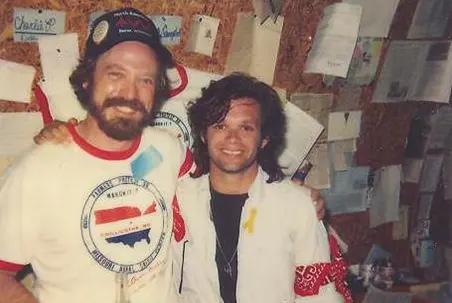
MRCC’s Rhonda Perry and Roger Allison send a message to John Mellencamp
Chillicothe 40 Years Later Part One
KURN: Welcome to Against the Grain, the Farm Aid podcast. I’m Jessica Ilyse Kurn,
FOLEY: And I’m Michael Stewart Foley.
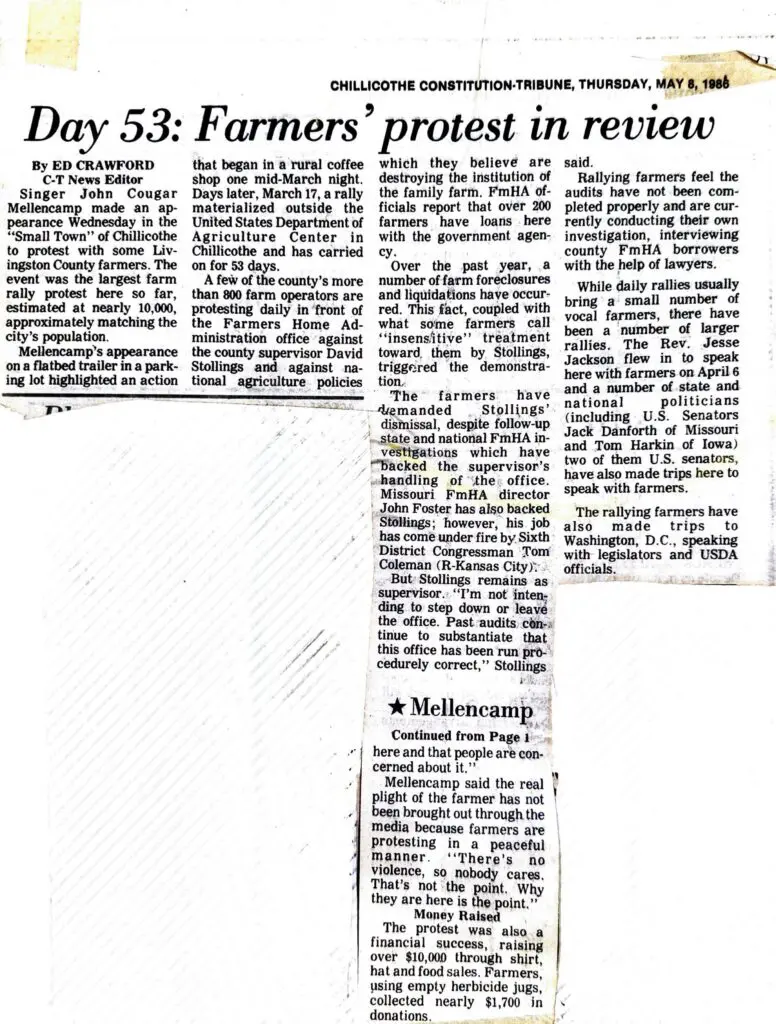
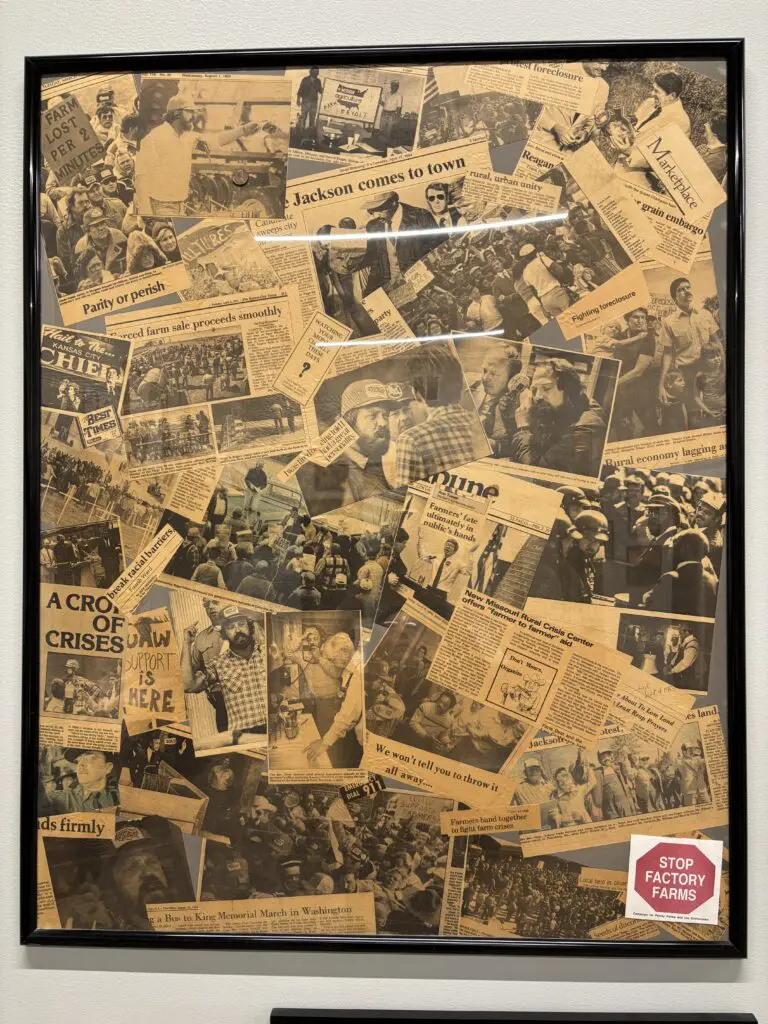
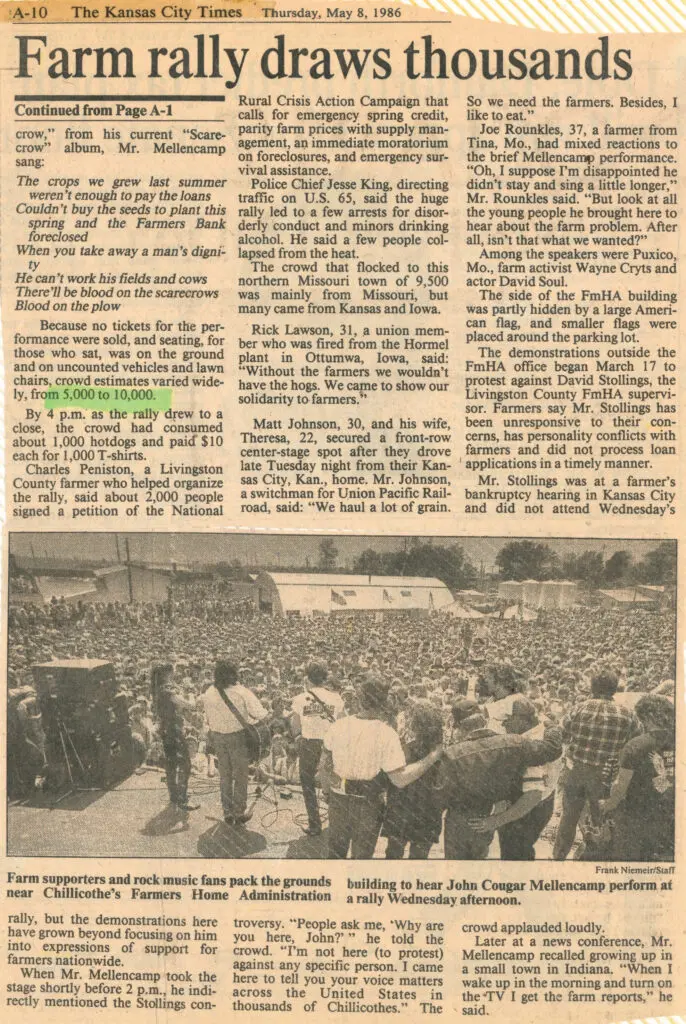
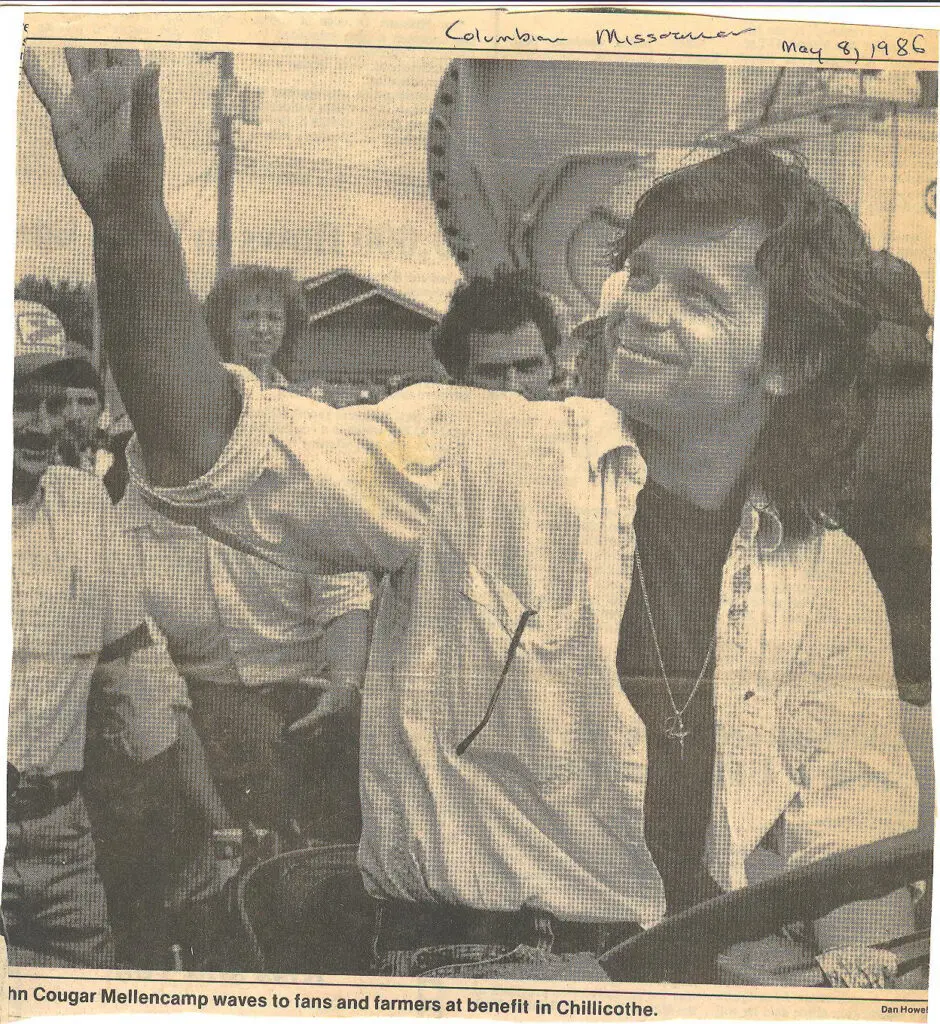
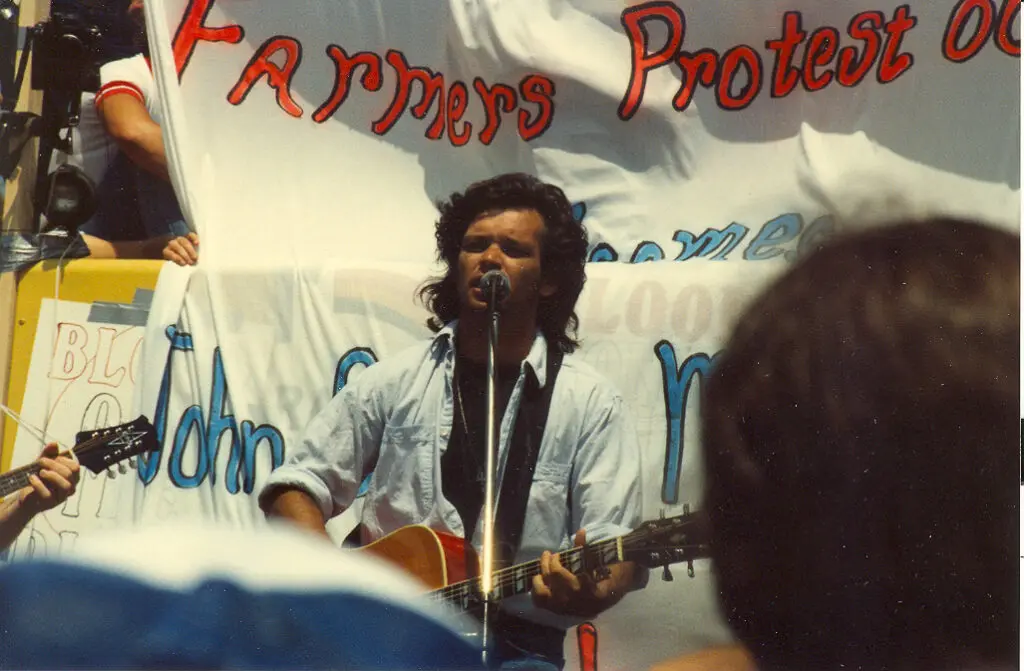
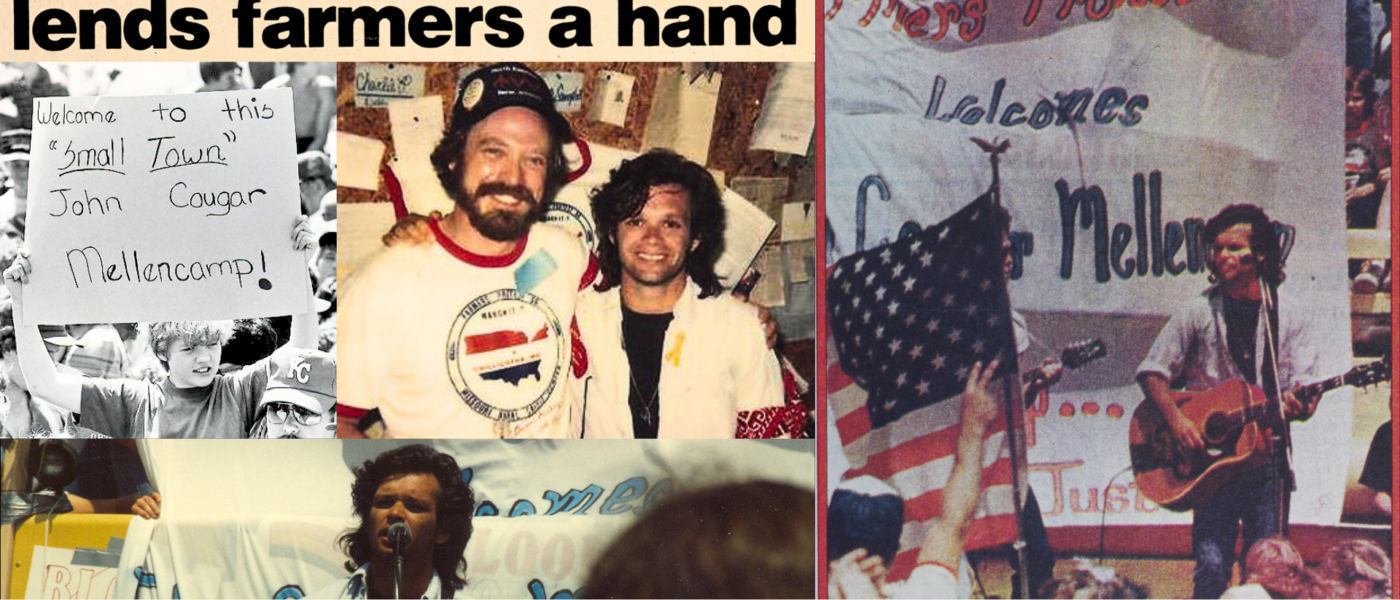
KURN: This is part one of a two-part story marking the 40th anniversary of a major event in the history of Farm Aid and the family farm movement. On May 7th, 1986, Farm Aid founder John Mellencamp joined a protest blockade of a USDA office in Chillicothe, Missouri.
FOLEY: Spotlighting this moment in history is important. It’s not a well-remembered story, for one thing. But it’s a pivotal moment in the history of the family farm movement. Chillicothe illustrates a time when farmers, rural people, and community members came together and stood up for one another and won.
KURN: We’ll hear from longtime organizers, Roger Allison and Rhonda Perry of MRCC, that’s the Missouri Rural Crisis Center, which spearheaded this protest, and from Farm Aid’s longtime executive director, Carolyn Mugar. And then we’ll hear John Mellencamp tell the story of why he was there too.
FOLEY: Chillicothe, a town of 10,000 people at the time, hosted over 100,000 people from all walks of life over this 145 day protest. From farm movement activists to civil rights organizers, to labor leaders, to the farmers down the road. And once again the cause was amplified by the power of music. We’ll get into it all, so stick around.
KURN: Your donation to Farm Aid strengthens family farmers so they can thrive and keeps them on the land where they belong. Together, we can make a real difference in our farm and food system. Head to Farmaid.org/podcast to make a gift today.
KURN: Welcome back. As you may know, Farm Aid started as a benefit concert organized by Willie Nelson, Neil Young, and John Mellencamp in 1985, in the middle of what’s known as the 1980s farm crisis.
FOLEY: Yeah, by the 1980s there was an entirely man-made epidemic of foreclosures, pushing farmers off the land. If you’re not aware of what was happening in farm country in the 1980s, the blog post that accompanies this episode explains it all in greater detail. But suffice to say, the farmers paid the price for governmental incompetence and bad policy.
KURN: This is where the Farmers’ Home Administration comes in. During this time, these offices were found in almost 1700 rural counties all over the United States, including one in Chillicothe, Missouri. This administration was set up as part of the USDA after the Second World War to help farmers with credit and technical assistance, but by the 1980s it had become adversarial and no longer a place farmers wanted to turn for support.
FOLEY: It’s also worth pointing out that Farmers’ Home administrators, as part of a wider pattern within USDA, discriminated against black and native farmers for decades. So for the hundreds of thousands of black farmers pushed off their land in the last century, the 1980s was not the first or last farm crisis.
KURN: There are two important things to know about farming. One is that farmers need loans at the start of the season for inputs like seeds and fertilizers, that’s way before they have anything to show for it. Two, these loans are risky, and that there’s no way to predict what will come of the crop months later. Will there be tornadoes, floods, low demand, low prices?
FOLEY: So in Chillicothe, Missouri, in the mid 1980s, an abusive Farmer’s Home administrator was not releasing much needed loan funds for the planting season. He also was known for ruthlessly pursuing foreclosures on farms that had been in families for generations. He was devastating this area of the rural countryside.
KURN: But he was messing with the wrong farmers.
ALLISON: Well, you know, just, uh, Missouri was number one in foreclosures across the country. Uh, we were, Number 2 in a number of hunger counties, and that uh we were number 3 in soil erosion and you put all those things together, there was a real clash.
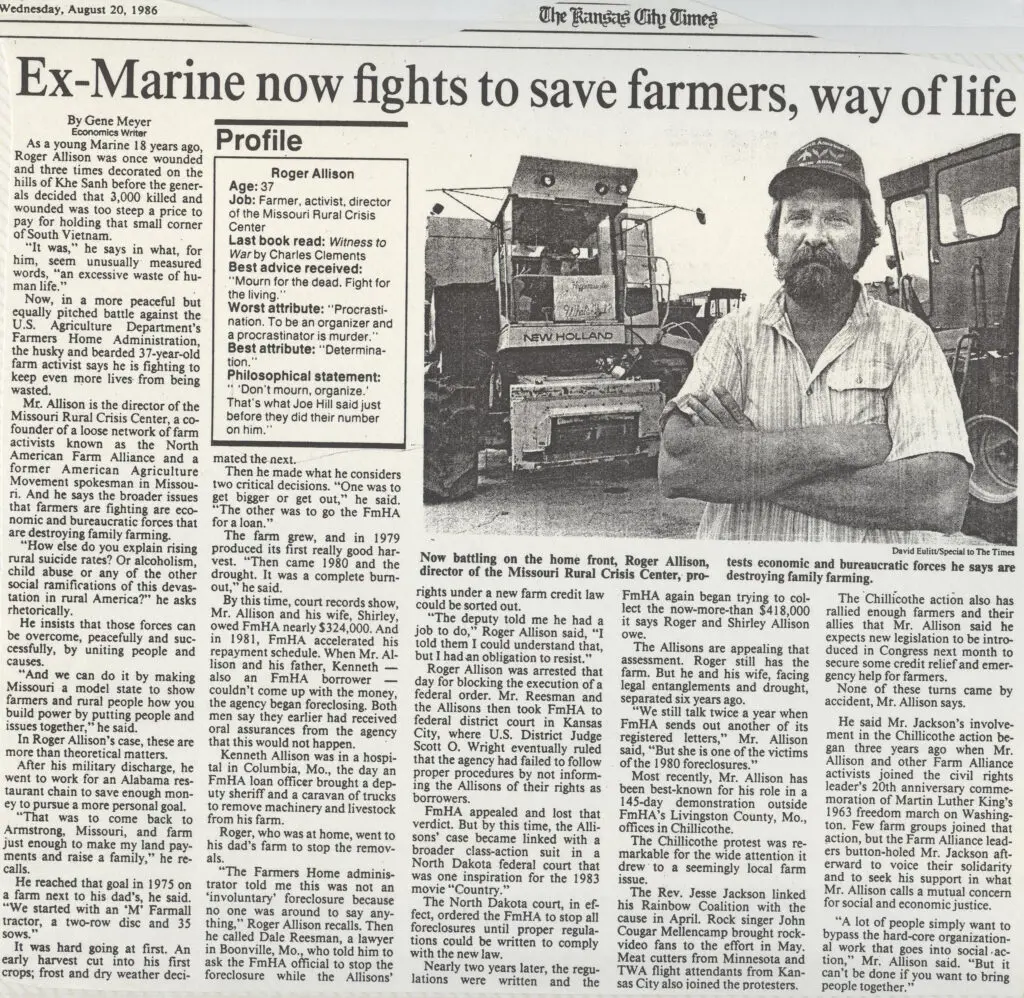
FOLEY: That’s Roger Allison. He founded MRCC in October 1985, with a $10,000 check granted from the proceeds of the very first Farm Aid concert. MRCC is central to the story of what happened 40 years ago in Chillicothe.
KURN: Yes, and so is Roger. He is a much beloved figure in the family farm movement. A decorated Vietnam veteran, he showed his activist chops in October 1980 when he physically stood in the way of the Farmers’ Home Administration officials who were foreclosing on his father’s farm, and then he was arrested. In response, they went after Roger’s farm next. But Roger sued in federal court and won in a landmark case, Allison v. Block. This case compelled the government to allow loan deferral options for farmers and set the precedent for a much bigger class action case called Coleman v. Block. You can learn more about all of this in the accompanying blog post.
FOLEY: This experience, combined with Roger’s grit, determination, and brilliant organizing instincts, led him to show up for other farmers in Missouri. We talked to both Roger and Rhonda Perry, MRCC’s current executive director.
PERRY: Roger was really out there doing some massive organizing, doing direct actions, penny auctions, courthouse step protests, like all the things to literally try to stop the sale of farms. So that was sort of the environment in which what was going on in Missouri at the time. So it was, there was a lot going on. The state like knew and Roger was very out there. Missouri Rural Crisis Center was, you know, a known entity that you could call for these things and who was organizing farmers to stand up.
FOLEY: Farmer-led protests have been happening since the late 1970s, but by 1986, the temperature was heating up, and Roger and MRCC were modeling tactics like sit-ins and penny auctions.
KURN: Hey Michael, explain a penny auction.
FOLEY: Right, that’s where farmers show up at farm auctions in large numbers and convince potential buyers not to bid more than a nickel or a dollar for anything. So the bank earns little, and the items purchased for pennies get returned to the family. When a farm was foreclosed upon, it was more than the closure of a small business. The farm was not only the farmers’ livelihood, but also their home. And often land that had been in their family for generations.
KURN: Yeah, the stress that comes with foreclosure also comes from being the very end of the line for your family’s way of life. There’s an immense pain and a sense of shame that comes with that. Protesters were making this point by driving crosses into the ground in front of county courthouses, representing each farm lost and each farmer death by suicide.
FOLEY: None of this happened overnight. Roger and Rhonda told us that prior to the Chillicothe campaign, a different farmer mobilization in Plattsburg, Missouri, about 45 minutes north of Kansas City, brought together a multi-racial working class coalition from all walks of life, all fighting for farmers. Here’s Roger again.
ALLISON: Before Chillicothe, we had just come off an action in Plattsburg where we had put thousands of farmers trying to save a farm of a uh 80-year-old, you know, farmer who had done a good job.
FOLEY: Roger’s referring to the fight to save Perry Wilson’s farm. Wilson had been farming his 800+ acres since 1933, and had never missed a payment until 1984. For that one slip up, he was being foreclosed upon. Despite a courthouse steps showdown with protesters shouting, “No sale! No sale!” the Wilson family lost its farm. Here’s Rhonda.
PERRY: At Plattsburg, it wasn’t just thousands of farmers there. It was also the Southern Christian Leadership Conference. It was Jesse Jackson who like joined and were at the front of the line. And because of the time we’re in today, I just sort of can’t not bring up that all of the, the police force in full riot gear were up against the farmers and who was standing between the farmers were the black preachers from Kansas City and Jesse Jackson [and United Auto Workers] and the labor unions. So those relationships had been being built during this, this period of time from ’80 to 85. Sometimes police in riot gear were there to, you know, knock your heads together and not let you do what you wanted to do.
So it was a scary time for people to stand up, but it shows how How desperate they were to save their farms that they would do this in Chillicothe and all the other places across the state.
KURN: So back to that abusive Chillicothe Farmers’ Home administrator in March of 1986.
ALLISON: He had, you know, farmers crying and, you know, begging him to give him another chance and, you know, and, and it, it went downhill from that. And so people had enough. We started strategizing on what we could do. We came up with: You know, we’re going to take all of our equipment and fill up the parking lot and surround the USDA building and take it over. And so, um, we agreed on the date and that morning,
PERRY: What was the date?
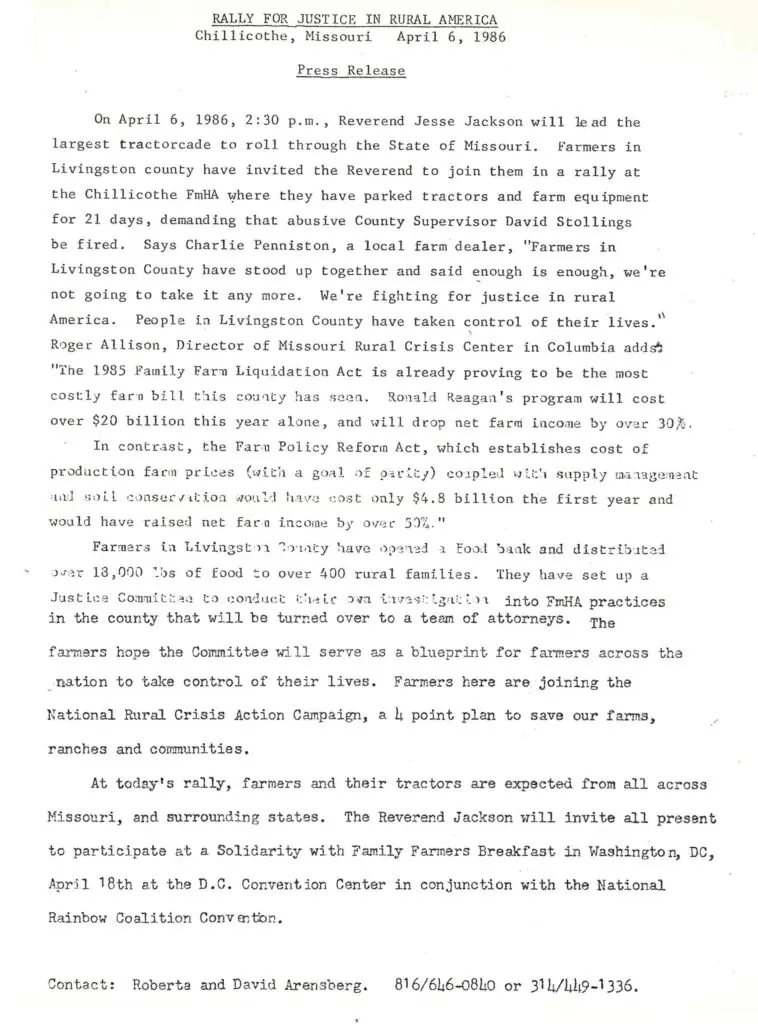
ALLISON: Well, what was it? The 17th, uh, the 17th of January was a jury [No, March] of March. Uh, the 17th of March was a jury day. So myself and there are about 7 or 8 other, you know, farmers, we were standing in front of the FMHA building and we started hearing the tractors, you know, come in and combines and people bringing manure spreaders and everything else they can, you know, bring and, uh, we filled up the parking lot and all the way around it and took over the building. And then laid our demands on the county supervisor.
FOLEY: Once the farmers occupied the parking lot, blocking the comings and goings, Roger and a carload of farmers decided to go up the chain of command and drove two hours to Columbia, Missouri to meet with the state director of the Farmers’ Home Administration.
ALLISON: We had a meeting with them and, you know, told them we want the county supervisor out of there, you know, that we wanted, uh, you know, the enforcement of 7 USC 1981A which Congress had passed to give farmers relief in situations, you know, where we were at right, right then and there, and they refused to do it. And they took out, you know, thousands and thousands of farmers just by them not writing the rules and regulations of 7 USC 1981A.
KURN: This law, 7 US Code 1981A, was already in the books, and Roger knew this. It allowed for loan deferrals to avoid farm foreclosures. Understandably, Chillicothe farmers were so infuriated with their county supervisor willfully ignoring the law, pushing farmers off their land.
FOLEY: It was this exact law that was the basis of Roger’s successful lawsuit, which saved his and his father’s farms.
ALLISON: Once they denied they were going to give us any relief at all, you know, we went back. And of course, you know, we figured, you know, they weren’t going to, you know, give us anything because all they had given us was foreclosure in the past, and we didn’t expect anything different from them, uh, you know, we, we just had to do what we could do in order to build the power. And so then, as, you know, the group of farmers were committed, that, you know, was a big deal because most of our actions lasted for a day.
FOLEY: But this action lasted for 145 days. We asked Roger about the blockade strategy and if they were planning to trap that county supervisor and his staff in the office.
ALLISON: I mean, when we first started off, it was a complete blockade where we wouldn’t let, you know, people come and go, uh, but then, um, you know, we were all going to go to jail. Uh, so, uh, we figured out another way that You know, still made the point. And so with this action, there was a commitment from the farmers that they would stay there as long as it took to get the county supervisor out. So with that, that really gave us a lot of room to organize and that, uh, we did tractorcades from town to town, you know, and held public meetings at all the FMHA offices in the different areas and asking for the demands of, you know, emergency food, uh, for families that, you know, needed assistance and needed emergency help. And it fell right in with, you know, a national plan of action that, uh, we called the Save the Family Farm Act that came out of, you know, a meeting with all the different farm groups in DC about what we needed. And so, we had a petition. That petition, you know, said we want a moratorium on farm foreclosures. We want the enforcement of 7 USC 1981. We needed emergency relief for farmers to pay, you know, their food bill, electric bill, feed their livestock.
KURN: Word spread fast. People came from all over Missouri and from all over the country to support this cause. And this was before anyone had email or cell phones, it just developed organically.
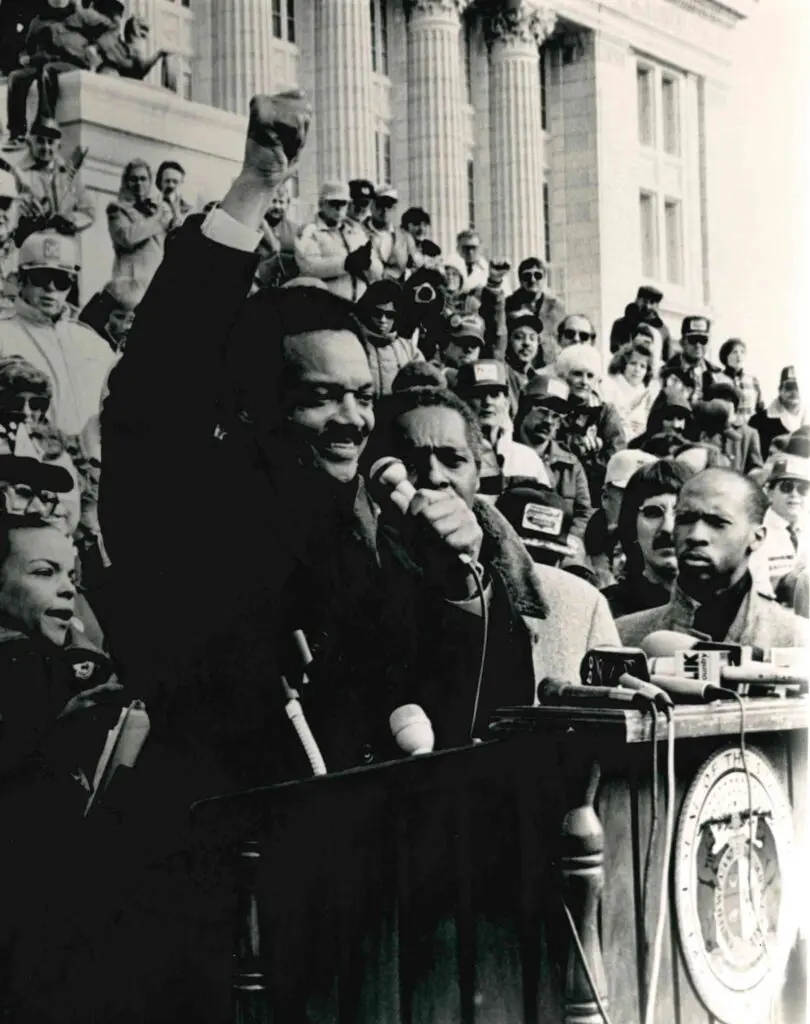
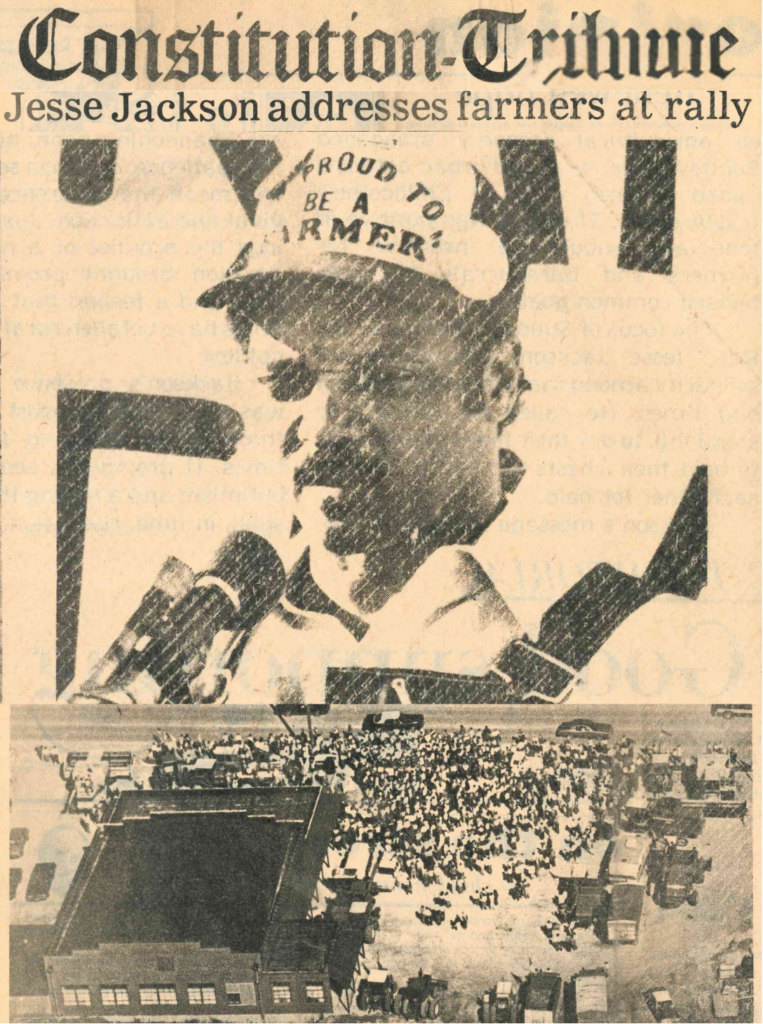
FOLEY: You could do a lot with a phone tree. So, every day for the next 145 days, farmers showed up. Some mornings it was only a handful, other mornings maybe 100 people. When national figures like Jesse Jackson and John Mellencamp came, it was thousands.
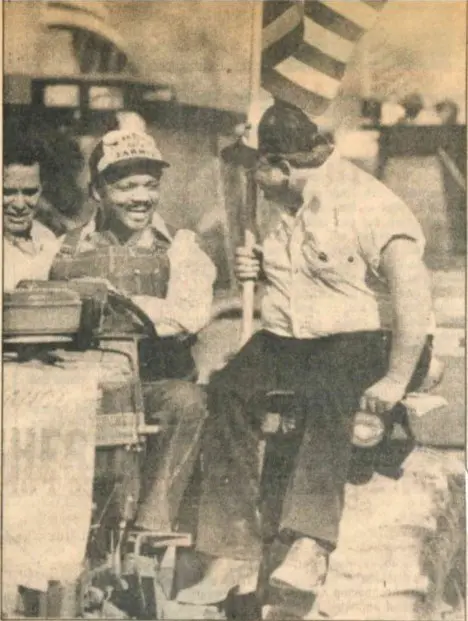
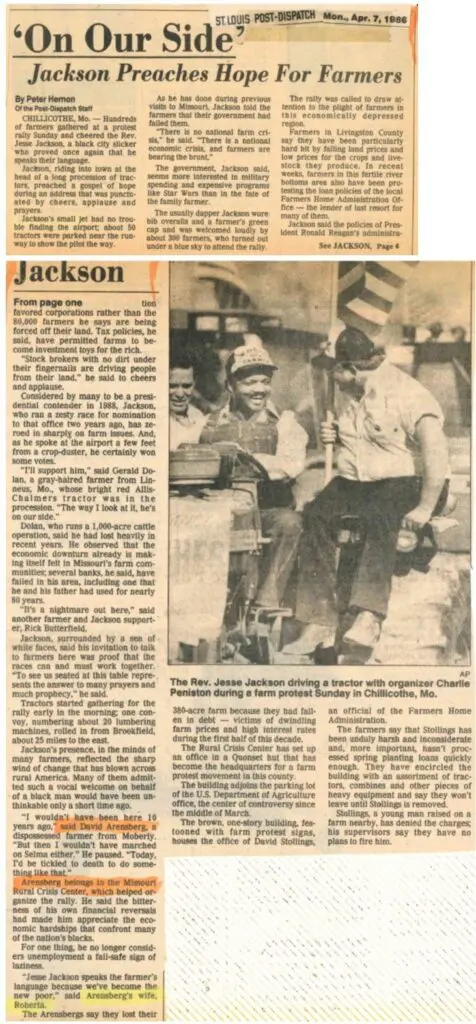
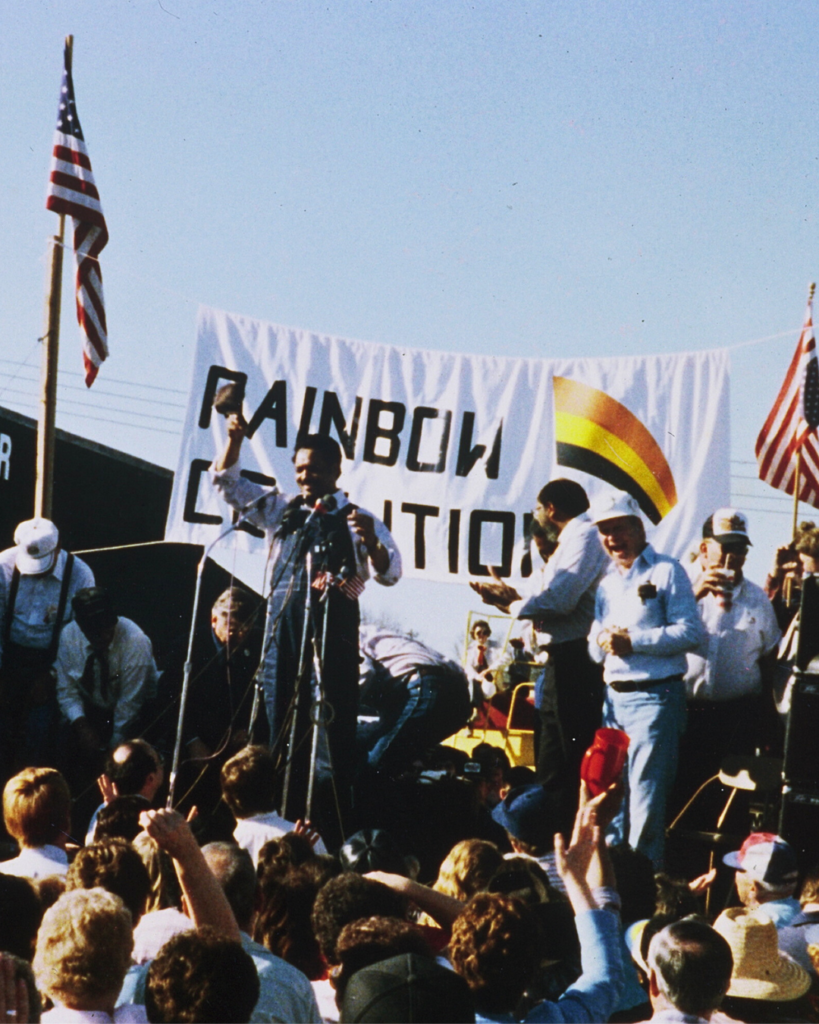
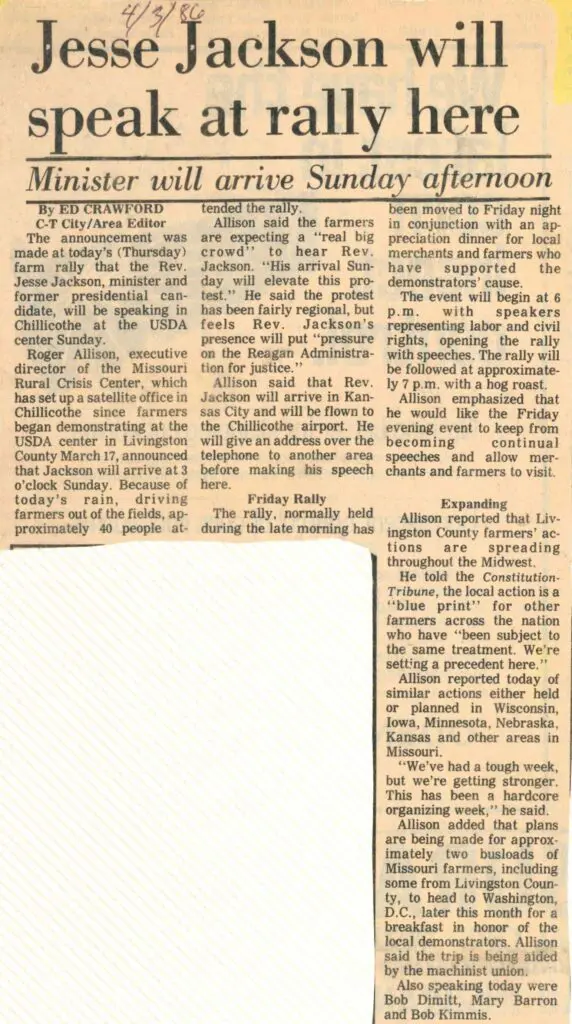
ALLISON: When we did, uh, Jesse Jackson, uh, we asked for, uh, you know, a highway patrol escort from, uh, the airport to where our same spot where, uh, John was at, they wouldn’t give it, so we put over 100 tractors together and uh took over 36 Highway with flags flying and Jesse in an open-air tractor sitting on the fender of it, wearing coveralls.
JESSE JACKSON: This crisis on the farm is a government-induced crisis. The government led you out on a limb and then chopped that limb!
KURN: We have old news clippings and photos of this on our website. Here’s the Reverend Jesse Jackson appealing to President Reagan directly.
JESSE JACKSON: I would ask him to grant some emergency money right now that they might plant now – grant some emergency money for food, healthcare, and housing, then restructure their loans and give them a way out.
FOLEY: As the blockade continued, the participants were steadily building the foundations of an organization that’s still with us.
PERRY: And this is sort of critical for a bunch of reasons because that’s also when Missouri Rural Crisis Center became a membership organization was like during this time, in part, to meet this demand that Roger was talking about and my parents were, you know, some of the first members who joined. Because that was the recognition of not just putting out fires every time, but building a long-term organization that was going to be able to take on these issues. Little did we know that 40 years later, we’re still be taking on these issues, but that was the time and it was, it was pretty cool. They had Monday night meetings and I remember always my dad saying he was going to go to the Monday night meeting, and one of my brothers would go with them sometimes. And that was the meeting where people literally came into the space together and where people’s lives were really like laid bare, like that degree of trust that had formed where people were saying, oh, I heard this person’s going out. I heard this. Well, I’m in the same situation…Like it wasn’t just like we’re going to demand the policies, but it is literally what kept people alive and capable of like functioning was being able to have that group.
There was a crisis hotline that Chillicothe was also participating in – both mental health crisis and also farm crisis – of how people could get involved. And I think that phone line was in that little Quonset hut. I mean this was all happening in a parking lot right connected to the USDA building.
FOLEY: What became a hotline operated 24 hours, 7 days a week, from basically a shed in the middle of the USDA parking lot.
KURN: Through all of these beautiful tactics, organizers protested, presented their demands, and provided on the ground assistance to those who needed it, all while trying to draw national attention to the plight of the farmers.
PERRY: If I’m just remembering this part correctly, you jumping on the phone with Carolyn. And..
ALLISON: Oh, I was on the phone with Carolyn quite a bit. You know, when, uh, when there’s some action going on, you know, Carolyn’s right there.
FOLEY: Carolyn is Carolyn Mugar, Farm Aid’s first executive director up through 2024. The person Willie Nelson turned to in 1985 to lead the organization in part because she had a long record as a labor organizer.
ALLISON: You know, it first started off, she organized all the different farm groups to get on the phone, and then I encouraged them to do some sort of an action in support of what we were doing in Chillicothe.
KURN: For what it’s worth, we did not interview Roger or Carolyn together, but as seasoned organizers who work shoulder to shoulder over the last 40 years, they were very much in sync and spoke admiringly of one another. Remember, at this point in 1986, both Farm Aid and MRCC had been around for only about 6 months. Here’s Carolyn.
MUGAR: When Roger decides to do something, he’s on it. And I think he was, that was a great, um, draw. I really think that was a positive draw. And he, it was like, yes, we were gonna succeed in it, in, uh Chillicothe. You know, we had to. Once you went out, you had to succeed.
MUGAR: I think that that’s what Farm Aid is about, which is being present when there is action on the ground of people really exercising their power. And it’s a place for us to be honored to support, and also, we’re looking for those opportunities all the time, and that’s exactly where we should be, and that speaks to the present. And that is something that I think is in the DNA, and I know is in the DNA of Farm Aid. It’s too much fun. Too much fun. You see an opportunity and you really, you know, they don’t come knocking that much. We, Farm Aid needed to be there. We needed to get everybody there we could and put everything behind it.
NEWSCASTER: Meanwhile, Chillicothe, uh, farmers are also gaining a lot of support from the country’s hottest rock and roll star. John Cougar Mellencamp has decided to put on a free concert to focus attention on the family farm crisis, and Chillicothe is getting ready for the expected crowd.
KURN: Putting everything behind it meant bringing in people who could draw a crowd.
MUGAR: And I always thought that that’s what the benefit of Farm Aid was – is that, you know, with, with the voices of artists who were picked up by many more people than maybe the farm news, um, we, we had a chance to get people’s support and their, you know, their understanding of what was going on. It was just a great chance.
MELLENCAMP: Hi, I’m John Mellencamp. It was pretty simple. Carolyn discussed the situation with me, and I got myself and my guitar player and my violinist, and we met with the people before. And they explained the situation to us. And then, uh, we sang.
KURN: It’s sort of ridiculous how simple he makes it seem. Carolyn called, we went, we sang!
FOLEY: In the second half of this two-part episode on Chillicothe, we’ll hear a lot more from Farm Aid founder John Mellencamp – not only about how he came to perform on the back of a flatbed truck in the USDA parking lot, but also his personal connection to the farm movement, and why he got involved with Farm Aid.
KURN: Thank you for tuning in to part one of Chillicothe, 40 years Later. Stay tuned for the second part coming soon. Also, be sure to head to our website where we’ll have all sorts of pictures, news clippings, music. It’s all right there, www.farmaid.org/podcast.
FOLEY: Is there something you want us to cover in the future? Send us an email or drop us a comment. You can email us at podcast@Farmaid.org and find us on social media, which is @FarmAid on Instagram, Facebook, Threads and Blue Sky.
KURN: And don’t forget YouTube, where you can watch almost 40 years of performances and other content. Let your friends know about Against the Grain. We’re beyond grateful when you listen, share, like and subscribe to this podcast.
FOLEY: Against the Grain was written and produced by us with sound editing by Endhouse Media and direction from Dawn Sorokin. And thanks to Micah Nelson for our fantastic theme music.
KURN: Thanks to everyone who took the time to speak with us. Head over to our website to learn more about each guest, Farmaid.org/podcast. And thanks to all the farmers out there. We’ll chat with you next time.
KURN: Your donation to Farm Aid strengthens family farmers so they can thrive and keeps them on the land where they belong. Together, we can make a real difference in our farm and food system. Head to Farmaid.org/podcast to make a gift today.