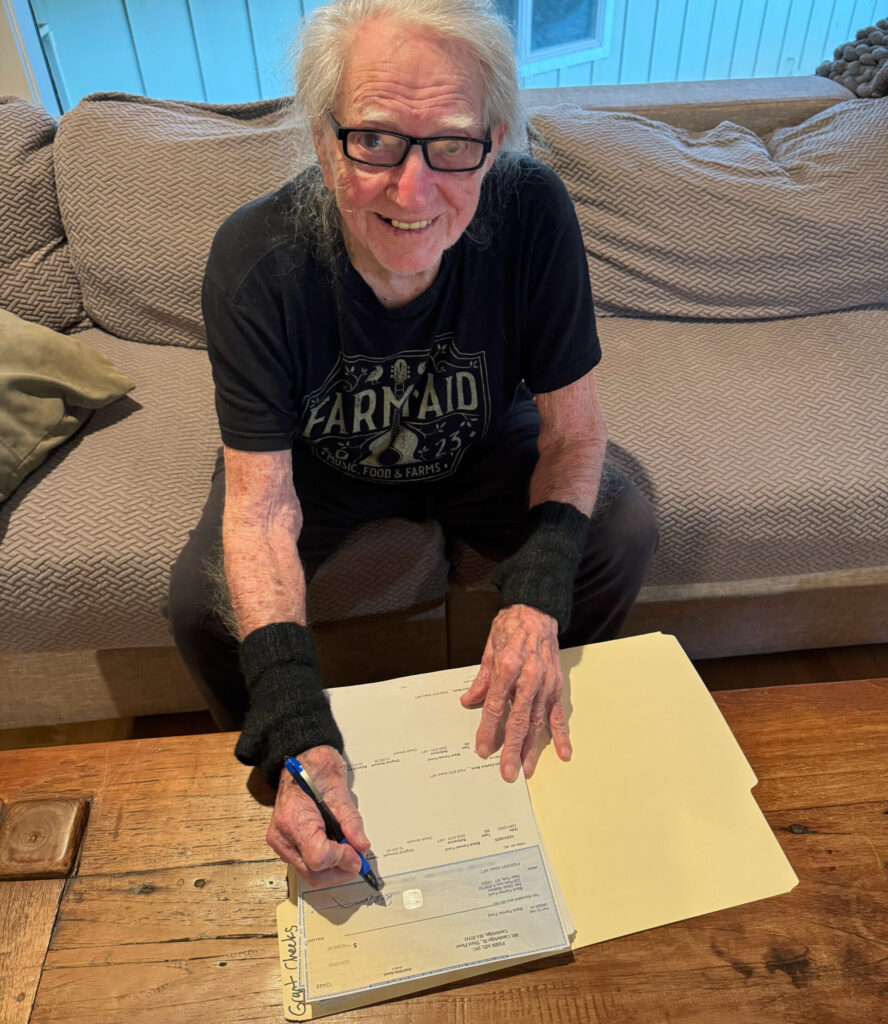
Farm Aid President Willie Nelson signing 2025 grant checks
Included in Farm Aid’s work to build a thriving family farm-centered system of agriculture is the Farm Aid grant program, which funds organizations serving family farms. Our grantees around the country are critical partners in the movement to keep family farmers on the land, producing good food for all.
In 2025, Farm Aid granted more than $1.3 million!
This month, Farm Aid distributed End of Year grants totaling $1,146,000 to 106 family farm, rural response and urban agriculture organizations. Earlier in the year, Farm Aid distributed more than $190,000 through other grantmaking programs, bringing the organization’s grantmaking total to more than $1,336,000 for the year.
“These organizations are the heart of the farm movement, with farmers at the center of their work and leadership. We are so proud and lucky to stand with them. Like Farm Aid, many of these folks have been working since the 1980s, and they continue to be crucial sources of strength for farmers and rural communities. This is especially important as farmers once again face trying times.” — Willie Nelson
These grant programs include:
- More than $60,000 in emergency and disaster grants to individual farmers with the assistance of Farm Aid’s Hotline team members.
- $26,500 in disaster grants to organizations providing direct support to farmers in response to climate disasters, such as those that provided vital relief to farmers in the Southeast devastated by hurricane Helene in late 2024.
- $40,000 in strategic grants to NOFA VT for grassroots efforts to secure emergency relief for farmers impacted by extreme weather events; Liberation Farm to support their advocacy, education and community building to address Black farmland equity, food sovereignty and liberation; Washington Young Farmers Coalition to expand its AgCare Fund, which provides direct aid to farmers and farmworkers to support mental health care; and CCOF to support expansion of the Hardship Assistance Fund beyond California, providing financial assistance to farmers experiencing financial loss due to extreme hardship.
- More than $40,000 in farmer leadership grants for the development of leadership skills among farmers and farmer advocates and the elevation of their voices in decision-making circles. This includes a $6,000 grant to American Agriculture Movement to create change for farmers, fisherman and ranchers by providing a voice, advising, advocating and demanding action.
- More than $20,000 in scholarship funds to support university students majoring in agriculture and related fields.
Growing the Good Food Movement
Creating and implementing innovative programs that build local and regional food systems and connect farmers directly to consumers.
20 organizations; total funding: $194,000
The Appalachian Center for Economic Networks (ACEnet), Athens, OH: $10,000 to work collaboratively with other Central Appalachia partners to build a fair food system in which beginning and established farmers, many traditionally marginalized in remote rural communities of Appalachia, can prosper through the equitable access of capital and business resources.
CitySeed, New Haven, CT: $10,000 to provide all New Haven residents with access to fresh, local food and to build economic opportunity in the food system.
Dream of Wild Health, Minneapolis, MN: $10,000 to create culturally-based opportunities for youth employment, entrepreneurship and leadership; increase access to Indigenous foods through farm production, sales and distribution; and engage community members through outreach around reclaiming cultural traditions, healthy Indigenous food, cooking skills and policy and systems change.
Dreaming Out Loud, Washington, DC: $10,000 to support their Urban Farms and food hub operations along with the DREAM Black Food Fund Initiative, with the goal to serve as a conduit for the creation of an integrated pipeline of revenue generating farms and employment opportunities.
Families Anchored in Total Harmony, Inc. (FAITH), Gary, IN: $8.000 to support urban youth in grades 6-12 to become the next generation of BIPOC farmers by providing agricultural training and development, and pathway towards building strong, self-sufficient communities.
Farm Fresh Rhode Island (FFRI), Providence, RI: $10,000 to build a strong and resilient local food system that values the environment, health and quality of life for the farmers and eaters in New England.
Green Village Initiative (GVI), Bridgeport, CT: $9,000 to support work at grassroots and state-wide levels to grow food, knowledge, leadership and community to create a more just food system.
Grow Pittsburgh, Pittsburgh, PA: $10,000 to address inequities in Allegheny County by supporting sustainable urban agriculture and fresh food distribution with an emphasis on the food-insecure communities of Braddock, Homewood and Wilkinsburg by providing the tools, resources and knowledge for people of all ages to grow their own food.
GrowNYC, New York, NY: $8,000 to provide access to healthy, fresh, locally grown food for all New Yorkers and support family farms in the Northeast and to provide training and technical assistance in both English and Spanish to GrowNYC Greenmarket and Wholesale farmers in the region.
MFU Bottleneck Project, Wabasso, MN: $10,000 to build a strong, community-based alternative to corporate consolidation in meatpacking through supporting local ownership and policy advocacy.
Northwest Indiana Food Council, Northwest Indiana: $10,000 for efforts to weave networks, develop programming and advocate for a more just food system that equally values farmers, food producers and honors the right to food for the most vulnerable community members.
People’s Cooperative Market, Bloomington, IN: $9,000 for investment in a cooperative curated by BIPOC and underserved farmers and vendors to produce and aggregate organic, nutrient dense culturally relevant food for distribution into oppressed communities.
Mino Bimaadiziiwin Tribal Farm (Red Cliff Band of Lake Superior Chippewa), Bayfield, WI: $10,000 to build a more resilient food system and advance the food sovereignty goals of the Red Cliff Band and Tribal producers through increased access to nutritious and traditional foods, targeted youth programming, technical support and outreach for producers, and stewardship of the land for the next seven generations.
Red Tomato, Providence, RI: $10,000 for efforts to identify marketplace barriers, innovate collaborative supply chain solutions and leverage brand and marketing collaborations so that eaters can act in support of independent growers in their region.
Soul Food Project, Indianapolis, IN: $10,000 to build a just and equitable food system in the community through urban farms, a youth employment program (Seeds to Leader) and an adult apprenticeship program (Roots to Leaders).
Sustainable Food Center, Austin, TX: $10,000 to empower Texas farmers and ranchers to achieve their business and regenerative farming goals by providing personalized technical assistance to help farmers operate more effectively, find buyers and network, improve their operations and succeed in an ever-evolving food system.
Teter Retreat and Organic Farm, Noblesville, IN: $10,000 to create an equitable food system that provides the nutrition, community and ecological healing that allows everyone to thrive.
The Hmong American Farmers Association (HAFA), West St. Paul, MN: $10,000 to empower Minnesotan Hmong farmer-entrepreneurs to equitably access critical training, resources and opportunities for business growth, build entrepreneurial capacity, claim equitable representation and increase intergenerational wealth.
The Livestock Institute of Southern New England, Westport, MA: $10,000 to provide small and mid-sized farmers with USDA-inspected processing, regenerative agriculture education and community-driven resources while building relationships among producers and consumers to strengthen the regional food system and increase access to high-quality, sustainable and humanely processed meat in Southern New England.
West Virginia Food And Farm Coalition, Charleston, WV: $10,000 to empower farmers by working with them to expand markets, secure agricultural investments and promote fair farm policies statewide. These initiatives boost economic resilience, encourage sustainable practices and ensure more West Virginians can access fresh, local food.
Helping Farmers Thrive
Providing farmers with support and resources to start farming, transition to more sustainable farming practices and/or continue farming in the face of financial crises and/or natural disasters.
52 organizations; total funding: $591,000
Agriculture and Land-Based Training Association (ALBA), Salinas, CA: $10,000 to help farmers thrive through on-farm education, technical assistance and subsidized access to organic farmland and equipment.
Alabama Sustainable Agriculture Network (ASAN), Birmingham, AL: $10,000 to coordinate knowledge sharing, build resources and strengthen networks of sustainable farmers and local food advocates to deepen relationships between the people of Alabama, the food we eat and the land.
Appalachian Sustainable Development, Duffield, VA: $10,000 to increase climate resilience and reduce the distance between consumers and their food source with training and technical assistance on entering into the food production economy.
Black Farmer Fund, New York, NY: $10,000 for efforts to invest in Black farmers and food actors to build a vibrant and resilient Black food system.
Braiding the Sacred, San Francisco, CA: $10,000 to support Indigenous corn and seed caretakers by rematriating seed varieties from their Seed Sanctuary to their mother nations.
Carolina Farm Stewardship Association (CFSA), Pittsboro, NC: $10,000 to support the administration of technical assistance for farmers across North and South Carolina, as well as the execution of a grassroots and grasstops advocacy plan to build a resilient regional food system that is sustainable for farmers and the environment.
Chester Agricultural Center, Chester, NY: $10,000 to empower a new generation of farmers, especially LGBTQ+ and BIPOC growers, by making Black Dirt farmland and essential infrastructure accessible and sustainable, utilizing organic practices, supporting early-stage farm businesses with business development resources and cultivating a collaborative farming community built on shared knowledge, infrastructure and long-term viability.
Community Involved in Sustaining Agriculture (CISA), South Deerfield, MA: $10,000 to strengthen farms by maintaining resilient businesses and engage the community to build the local farm and food economy.
Connecticut Farmland Trust, Hartford, CT: $10,000 to support the success of current and next generation of farmers in Connecticut through protection of soil and water and by matching farmland owners with new farmers.
Cultivate Kansas City, Kansas City, MO: $10,000 to grow food, farms and community in support of a sustainable, equitable and healthy local food system for all.
Farmers Rising, Caledonia, IL: $10,000 to prepare the next generation of sustainable farmers and foster long-term food systems change in the upper Midwest through farmer training, land and food access, and public education.
Farmers’ Legal Action Group (FLAG), Saint Paul, MN: $30,000 to address legal needs of family farmers by: providing free legal services to farmers in need, especially underserved/BIPOC farmers; guiding rural farmers and members through the provisions of new federal and state legislation designed to benefit them; ensuring that family farmers and their communities have access to federal assistance programs, including new initiatives built around racial justice and climate change; and advising USDA on opportunities to use existing but underutilized legislative and regulatory authority to benefit family farmers in areas of credit, disaster assistance, climate mitigation and other areas.
Flanner House (Flanner Farm), Indianapolis, IN: $8,000 to continue efforts in producing naturally grown, affordable produce in an area that has suffered generations of environmental racism and food apartheid.
Food Works, Carbondale, IL: $10,000 to support peer-to-peer farmer training and programming to improve access to markets, thereby promoting long-term farming networks that create healthy soils, healthy food and healthy communities in the 23 counties that make up Southern Illinois.
Frogtown Farm, Saint Paul, MN: $10,000 to support community-led urban agriculture, grower incubation and value-added product development that equips beginning and BIPOC farmers to build viable farm businesses, steward land regeneratively and strengthen local food systems in Minnesota’s urban core.
Georgia Organics, Atlanta, GA: $10,000 to support programs that strengthen Georgia farmers and their communities by providing technical assistance and education, financial support and interpersonal connections to promote resilient, climate-smart and sustainable farming systems.
Holistic Management International (HMI), Albuquerque, NM: $10,000 to provide farmers with knowledge, skills, resources and ongoing support to be successful in regenerative agriculture via regenerative agriculture workshops, online training, Open Gate Field Days and one-on-one support.
Hoosier Young Farmers Coalition, Indiana: $2,000 to recruit, support and promote young and beginning farmers throughout the state of Indiana in order to make food systems more localized, sustainable and just.
Human Agricultural Cooperative, Fort Wayne, IN; $10,000 to support their cooperative farming model with not only knowledge and funding for farmers but also with equipment sharing.
Intertribal Agriculture Council, Billings, MT: $20,000 To support the Regenerative Economies Program, which provides business planning, financial guidance and technical assistance to Native farmers and ranchers, while fostering healthy, sustainable and resilient food systems in Indian Country.
Kilimo Minnesota, Cambridge, MN: $10,000 to strengthen a cooperative-based farming system that empowers African immigrant farmers and other BIPOC farmers through equitable land access, leadership development and sustainable agriculture.
KNOX, Hartford, CT: $10,000 to provide beginning farmers with land, training, mentoring and connections to enter careers as farmers in the agricultural industry or start their own farm-based businesses.
Land For Good, Keene, NH: $10,000 to expand secure farmland access, tenure and transfer to keep farmland in farming, and ensure that farmland access is secure, equitable and affordable.
North Carolina Association of Black Lawyers Land Loss Prevention Project, Durham, NC: $20,000 to support robust legal representation, technical assistance and policy advocacy to preserve land tenure and farm businesses, advance sustainability and promote greater equity in and access to farm programs for BIPOC and limited resource producers.
Legacy Taste of the Garden, Princeton, IN: $10,000 to build programs and events that support farmer advocacy, providing information on opportunities, training and assistance focused on Black and historically underserved farmers to participate and collaborate to build, save and strengthen Black farms and farmers.
Maine Organic Farmers and Gardeners Association, Unity, Maine: $10,000 to transform the food system by supporting farmers, empowering people to feed their communities, and advocating for an organic future.
Marbleseed, Spring Valley, WI: $10,000 to support the Grow Organic Program, which fosters farmer-to-farmer engagement, through farmer-led events, and provides relevant and timely resources for the organic farming community, in an effort to both strengthen the current sustainable farming movement and empower the next generation of organic farmers.
Michael Fields Agricultural Institute (MFAI), East Troy, WI: $10,000 to strengthen underserved farmers across the Upper Midwest through peer-to-peer technical assistance, farmer-led research and policy advocacy.
Midwest Farmers of Color Collective, MN: $10,000 to support an organizing and basebuilding organization that advances racial equity and climate resilience by providing resources for capital and land access, policy advocacy and fostering farmer-led climate solutions through agroecological practices and local food systems.
National Center for Appropriate Technology (NCAT), Butte, MT: $10,000 to support small and mid-scale family farmers, underserved farmers and ranchers and their communities in designing and implementing on-the-ground practices that conserve natural resources and maximize profits.
Nebraska Rural Response Council and Hotline, Lincoln, NE: $12,000 to administer the Nebraska Rural Response Hotline, which provides emergency food pantry assistance, AgrAgility for families impacted by disabilities, farm finance, bookkeeping and legal counseling and services, mediation services and mental health vouchers to farm and rural families.
New Entry Sustainable Farming Project, Beverly, MA: $10,000 to train and support new farmers, encourage resilient farming practices, facilitate access to local food and farm products and build strong support networks for diverse agricultural communities.
Northeast Farmers of Color Land Trust, Boston, MA: $10,000 to support land justice, reparations and community-led sovereignty initiatives that secure permanent land access for Black, Indigenous and people of color (BIPOC) farmers and land stewards in the Northeast through policy advocacy, direct land acquisition, technical assistance and community organizing that addresses systemic barriers to land ownership and agricultural success.
The Northeast Organic Farming Association (NOFA), with chapters in CT, MA, NH, NJ, NY, RI and VT: $10,000 for continued collaboration to elevate the voices of northeast organic farmers in both state and federal policy advocacy, including during and following the Farm Bill process, in order to build a more just food system that harnesses the power of agriculture to confront the climate crisis.
Operation Spring Plant, Inc. Oxford, NC: $10,000 to empower BIPOC and small family farmers with knowledge and support to ensure equity and inclusion in the marketplace, and to provide education and funding to assist with clearing hurdles on the path to successfully producing and marketing healthy non-GMO food while protecting the environment.
Organic Farmers Association, Spirit Lake, IA: $10,000 to organize opportunities for domestic organic farmers to advocate for a more just and ecological food system that prioritizes organic production for its social and ecological benefits and to expand access to organic food and farming to all communities.
Pasa Sustainable Agriculture, Harrisburg, PA: $10,000 to equip farmers with the knowledge, experience and tools they need to operate financially viable, environmentally sustainable, climate smart and socially just farm businesses through education, training, community and advocacy.
Practical Farmers of Iowa (PFI), Ames, IA: $10,000 to support farmer-led community engagement and outreach to Spanish-speaking communities in Iowa through farmer-led media production delivered in Spanish. PFI has a 35+ year history of farmer-to-farmer education and networking, and they’re currently growing their network of Spanish-speaking farmer-leaders with programming to address their challenges.
The Quivira Coalition, Santa Fe, NM: $10,000 to build resilience on working agricultural lands; provide apprenticeships for the next generation of regenerative ranchers; provide technical assistance for historically underserved and new and beginning producers looking to improve soil health, develop drought resilience and combat climate change; and build a community of practice around agriculture that addresses ecological, economic and social challenges in the western U.S.
Rock Steady Farm, Millerton, NY: $10,000 to increase equity in the food system through advocacy, community building and training and support programs for queer and trans Black, Indigenous and people of color (QTBIPOC) farmers.
Oregon Farm Corps, Portland, OR: $10,000 to support the training and equipping of an equitable, regenerative and resilient next generation of farmers through educational on-farm training, business technical assistance, advocacy for equitable farm practices and policies, and collaboration to preserve Oregon’s rich farmland.
Rural Advancement Foundation International-USA (RAFI), Pittsboro, NC: $20,000 to improve racial equity, farm viability and sustainability, and create systemic change for small and mid-scale farmers.
Sharing Our Roots, Northfield, MN: $10,000 to support a commons-based farming model that shifts land, resources and decision-making power to BIPOC, immigrant, refugee and LGBTQIA+ farmers who have been traditionally excluded from farming in the community.
The Southwest Georgia Project, Albany, GA: $12,000 to support The Table, a community resource to connect underserved farmers in Southwest Georgia with consumers.
The Carrot Project, Boston, MA: $10,000 to deliver high-impact business support services uplifting the prosperity of New England farmers and to lead transformational change across the agricultural system that ensures the capacity to provide these essential services is built into our sector long-term.
Farmworker Association of Florida, Apopka, FL: $12,000 to support agroecology programs in community gardens, provide direct assistance to farmworkers in crisis, grow our membership base and build leadership, civic engagement and activist skills among low-income communities of color who are disproportionately affected by pesticide exposure/health problems, environmental contamination, institutional racism, harassment and intimidation, exploitation and political under-representation.
The Federation of Southern Cooperatives/Land Assistance Fund, Southeast: $35,000 to support their work on racial equality for Black farmers, landowners and cooperatives across the rural South.
The Food Group, New Hope, MN: $10,000 to support land-based organic and sustainable agriculture education for farmers who have historically been underrepresented in farm ownership, including BIPOC and New American farmers.
The Land Connection, Champaign, IL: $10,000 to provide wraparound services to early and mid-career farmers including education around organic production and transition, financial risk management and business administration skills needed to grow environmentally, socially and economically viable farms.
The Veteran’s Farm of NC, Inc., Cameron, NC: $10,000 to support VFNC’s work to give military veterans and their families the opportunity at no cost to learn about agriculture, production skills in hydroponics, livestock, poultry, horticulture, fruit and vegetable production and more!
Transplanting Traditions Community Farm, Chapel Hill, NC: $10,000 to support current and future immigrant and refugee farmers in North Carolina to achieve their dreams of growing a farm operation, redistributing generational wealth, and contributing their unique skills and knowledge to the local food system.
Wisconsin Farmers Union, Chippewa Falls, WI: $10,000 to support boots-on-the-ground efforts to empower farmers to lead the fight against climate change and corporate consolidation in agriculture by strengthening local, grassroots networks by expanding and empowering local leaders, uplifting farmers’ voices, and providing connection while building the local capacity needed to drive meaningful, structural change in the food and farming system.
Taking Action to Change the System
Working to promote fair farm policies and/or grassroots organizing campaigns to defend and bolster family farm agriculture on a local, regional or national level.
34 organizations; total funding: $361,000
Agricultural Justice Project, Gainesville, FL: $5,000 to document the successes and challenges of their coalition of farmworkers, organic farmers and other community stakeholders over 25 years, working to build a food system that honors all who labor in it.
Animal Agriculture Reform Collaborative, National: $11,000 to support a uniquely facilitated, behind-the-scenes, multi-sectoral space that allows community leaders, experts, funders and other advocates across the many strands of food justice to come together to align, catalyze and accelerate animal ag reform work that needs central coordination to take collective action.
California Climate & Agriculture Network (CalCAN), Sacramento, CA: $12,000 to accelerate the transition to a climate-resilient agriculture system by advocating for policies and funding that provide resources for California farmers and ranchers to support the widespread use of practices that deliver climate and other environmental, health, economic and social justice benefits.
Center for Rural Affairs, Lyons, NE: $10,000 for efforts to advance equity and market access for beginning and underserved producers through the farm bill, appropriations and administrative advocacy.
Community Alliance with Family Farmers, Davis, CA: $10,000 to educate and organize small, underserved and BIPOC family farmers to participate in and survive the implementation of the Sustainable Groundwater Management Act (SGMA), which seeks to reach sustainable groundwater usage in the state.
Community Farm Alliance, Berea, KY: $10,000 to ensure Kentucky farmers, especially those facing systemic disadvantages, continue to have a voice in the farm and food policies that impact them, through the facilitation of grassroots dialogue and community organizing, paired with providing leadership development and advocacy opportunities.
Dakota Resource Council, Bismarck, ND: $10,000 to support family farmers and ranchers, promote soil health, and stop industrialized agriculture from proliferating in North Dakota.
Dakota Rural Action (DRA), Ancestral lands of the Oceti Sakowin (the Dakotas, South Dakota): $10,000 for efforts to stop Confined Animal Feeding Operations (CAFOs) from being sited in rural South Dakota while supporting and establishing pasture based regenerative systems.
Family Farm Defenders, WI: $10,000 for organizing around the principles of food sovereignty and agroecology to transform the US food and farm system with a goal to de-corporatize, deindustrialize, decommodify in favor of relocalizing, redemocratizing and reclaiming agri-culture.
Farm and Ranch Freedom Alliance, Cameron, TX: $10,000 to promote systemic reform in agricultural policy to benefit independent family farms and increase agricultural resilience, and to empower farmers and ranchers with the tools and the confidence needed to raise their voices for the change they want to see, both individually and by bringing together diverse coalitions.
Friends of Family Farmers, Junction City, OR: $10,000 to support a biennial farmer-led policy creation process from their statewide farmer base in Oregon using a statewide survey and 8 focus groups to determine farmer priorities, identify farmer champions and develop creative, producer-led solutions.
Illinois Stewardship Alliance, Springfield, IL: $10,000 to train and empower local and regenerative farmers in organizing and change-making, and mobilize a broad base of eaters, to advance state and federal policies for just and regenerative food systems that build the health and wealth of Illinois communities.
Idaho Organization of Resource Councils, Boise, ID: $10,000 to support farmworkers dealing with the effects of climate change specifically around extreme heat, smoke inhalation and pesticide poisoning that can affect the food system.
Institute for Agriculture and Trade Policy (IATP), Minneapolis, MN: $10,000 to build a better policy framework at the state and national level that supports farmers, communities and the climate via research, analysis and narrative campaigns that strengthen the policy goals of family farm groups.
Iowa Citizens for Community Improvement, Des Moines, IA: $10,000 to support grassroots organizing to protect family farms, rural communities, water and the planet from economic and environmental destruction caused by corporate factory farms.
Kansas Farmers Union, McPherson, KS: $10,000 to empower and engage family farmers, ranchers and communities through organization, education and cooperation and legislation.
Land Stewardship Project (LSP), Minnesota: $12,000 for creating transformational change in our food and farming system by fostering an ethic of stewardship for farmland, promoting sustainable agriculture and developing healthy communities.
Missouri Rural Crisis Center, Columbia, MO: $12,000 to build on their 40 year foundation of organizing a diverse farm and rural base to remain actively engaged in advocacy efforts at the local, state and national levels addressing the intersection of social, racial, economic, environmental and food justice that impacts all of our lives.
National Family Farm Coalition, Washington, DC, and Gloucester, MA: $20,000 to organize family farmers, ranchers and fishermen across the country, unite their diverse voices in policy solutions and build a movement that drives transformative change in our food system.
National Sustainable Agriculture Coalition (NSAC), Washington, DC: $10,000 to support grassroots advocacy that defends and advances sustainable and equitable federal food and farm policies and programs while amplifying farmer voices through coordinated national action.
National Young Farmers Coalition, Hudson, NY: $10,000 to equip young and BIPOC (Black, Indigenous, people of color) farmer leaders in their nationwide network with the resources, organizing and policy advocacy infrastructure they need to drive structural change and win a more equitable future for US agriculture in the upcoming Farm Bill and beyond.
Northeast Organic Dairy Producers Alliance (NODPA), Deerfield, MA: $8,000 to advocate for a fair and equitable sustainable pay price, integrity of the organic regulations, and ethical, ecological and economically sustainable organically certified farming practices, and to deliver education and industry information to organic dairy producers.
Northern Plains Resource Council, Billings, MT: $10,000 to organize Montanans to advance soil health as a farmer-led solution to climate change and combat industrial growth and corporate manipulation in agriculture so that family farms and ranches can thrive.
The Ohio Ecological Food and Farm Association (OEFFA), Columbus, OH: $10,000 to advance a narrative for change, to continue building a base of farmer and community leaders and to advance campaigns, prioritizing farmer-led solutions to climate change at the state and federal levels and support for farmer transition to organic and regenerative agriculture.
Organic Farming Research Foundation, Santa Cruz, CA: $10,000 to increase organic acreage as a climate change solution through stronger investments in organic research, education and federal policy.
Organic Seed Alliance, Port Townsend, WA: $10,000 to conduct legal and cultural advocacy toward policies that support organic agriculture and farmers’ rights to save seed and monitor organic seed systems in the US through their State of Organic Seed (SOS) project and report.
Partners IN Food and Farming, Crothersville and Indianapolis, IN: $8,000 to support their statewide Technical Assistance Network, advancing mentorship, land access and market opportunities for small and BIPOC farmers across rural and urban communities, while promoting equity and climate resilience through farmer-led solutions.
Powder River Basin Resource Council, Sheridan, WY: $10,000 to increase soil health, market opportunities and financial sustainability for independent food producers and increase the number of Northeast Wyoming family farms and ranches who utilize soil health and regenerative agriculture processes for increased local food production and climate resilience. Additionally, to help empower members to participate in legislative and agency advocacy to stop the corporate agriculture industry’s monopolization of America’s food production systems.
Real Food Challenge, National: $10,000 to support the needs of regional producers wanting to move towards institutional markets by facilitating connections and negotiations between colleges and universities and local producers while supplying these farmers with technical support and other resources that are required to meet institutional procurement needs while also building student power to hold their institutions accountable.
Rural Coalition, Washington, DC: $15,000 to change the system of extraction, exploitation, dispossession and disenfranchisement by sustaining a durable network of deeply rooted community organizations collaborating to catalyze their vision for just futures for their rural communities.
Rural Vermont, Montpelier VT: $10,000 for organizing, education and advocacy that centers and supports agrarians, their communities and the ecosystems they inhabit. We work towards an equitable, inclusive, accessible and resilient farm and food web through an intersectional, grassroots, and collaborative framework.
Socially Responsible Agriculture Project, Claymont, DE: $18,000 to support rural residents, independent farmers and ranchers, and community groups across the US through education, issue advocacy and organizing to protect rights to clean water, air and soil and to a healthy, just and vibrant food future.
Western Colorado Alliance, Grand Junction, CO: $10,000 to expand local market access for Western Slope producers; to build the advocacy skills of agricultural producers; and work to fund the Colorado Department of Agriculture STAR soil health program.
Western Organization of Resource Councils Education Project, Billings, MT: $10,000 for their agriculture and food justice campaign to advance policies that benefit independent family farmers and ranchers, farmworkers and rural communities. This is a critical moment of opportunity to advance historic new fair and competitive markets rules under the Packers and Stockyards Act, as well as winning meaningful policies for livestock markets, soil health and farmworkers in the Farm Bill.